Westerosi religion explained is one of the most underappreciated topics in the entire Game of Thrones universe. Most viewers come for the politics and stay for the dragons, but the spiritual landscape of Westeros is quietly one of the richest and most consequential layers of world-building George R.R. Martin created. Westerosi religion explained properly reveals how deeply faith shapes everything in the story — from which houses hold power, to how wars are justified, to what characters believe about death, destiny, and the supernatural. Westeros is not a secular world.
It is a continent defined by competing faiths that each claim exclusive truth, each demand different loyalties, and each carry real political weight in ways that directly influence the events of Game of Thrones, House of the Dragon, and the broader Targaryen saga. Understanding westerosi religion explained means understanding the full texture of a world where gods may or may not exist — but where belief in them shapes history regardless.
The Faith of the Seven: Westeros’s Dominant Religion
The Faith of the Seven is the most widely practiced religion in Westeros south of the Neck, and westerosi religion explained begins here. Brought to the continent by the Andal invaders thousands of years before Game of Thrones begins, the Faith worships a single deity with seven distinct aspects or faces — the Father, the Mother, the Warrior, the Maiden, the Smith, the Crone, and the Stranger. Each aspect represents a different dimension of human life and experience: justice, mercy, courage, innocence, labor, wisdom, and death respectively.
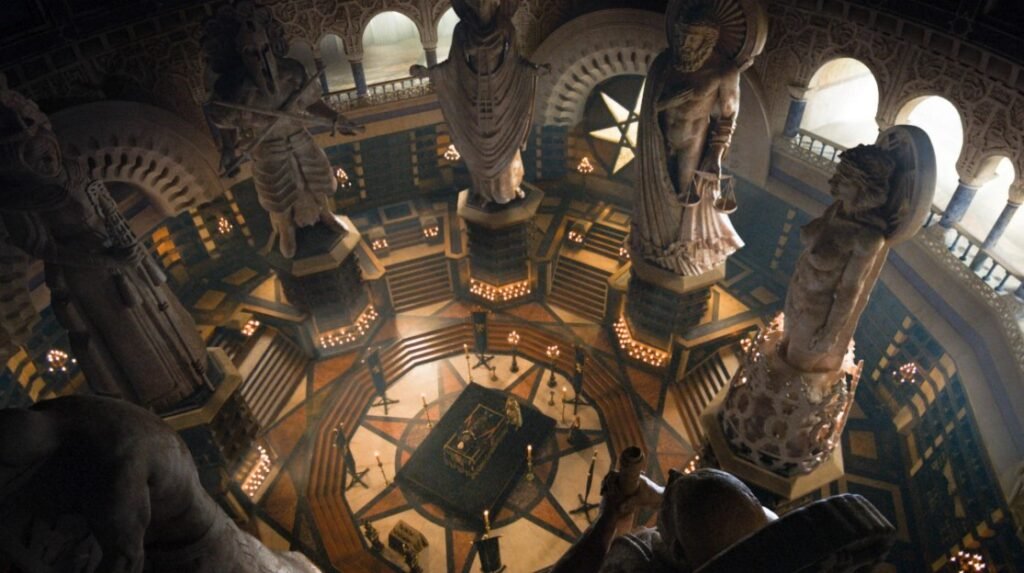
Worship takes place in seven-sided buildings called septs, presided over by a clergy known as septons and septas, with the High Septon serving as the faith’s supreme leader in King’s Landing. The institutional power of the Faith of the Seven in westerosi religion explained cannot be overstated — it legitimizes kings, performs marriages, anoints heirs, and in the most extreme cases mobilizes military force through the Faith Militant, an armed wing of devoted soldiers who appear in both Game of Thrones and House of the Dragon.
The destruction of the Great Sept of Baelor by Cersei Lannister — along with most of the Faith’s leadership — is one of the most politically catastrophic single acts in the show precisely because it severed the crown’s relationship with the religious institution that had legitimized Westerosi rulers for centuries.
The Old Gods: The Ancient Faith of the North
North of the Neck, westerosi religion explained takes a completely different form. The First Men — the original human inhabitants of Westeros before the Andal invasion — worshipped the Old Gods, a pantheon with no fixed number, no written scripture, no clergy, and no temples. Their sacred spaces are godswoods: groves of trees centered on a heart tree, typically a weirwood with a carved face, through which the Old Gods are believed to observe and receive prayers. The North retained the Old Gods after the Andal invasion largely because the Andals never fully conquered it, making the Stark family and their bannermen among the last major houses in Westeros to practice the ancient faith.
In westerosi religion explained, the Old Gods carry particular narrative weight because they are tied directly to the magical infrastructure of the story — the greensight, the Children of the Forest, and Bran Stark’s transformation into the Three-Eyed Raven all connect to the network of weirwood trees that the Old Gods communicate through. Unlike the Faith of the Seven, the Old Gods make no moral demands and offer no afterlife — they are ancient, inhuman presences whose interest in human affairs is at best ambiguous and at worst entirely instrumental. Our full breakdown of Greensight Explained explores how this magical connection works in practice.
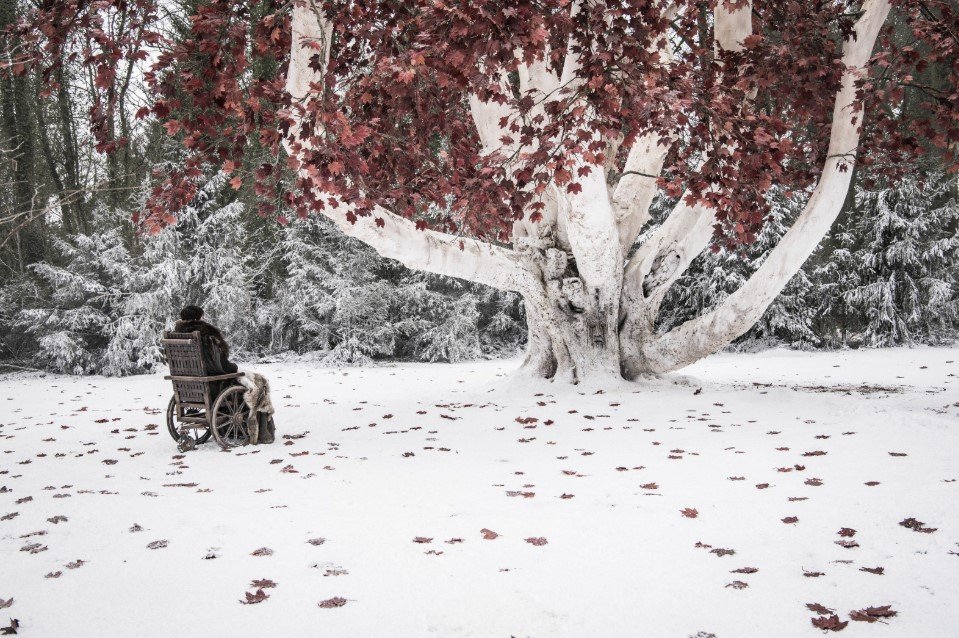
Description: The sacred weirwood heart tree in the godswood of Winterfell — the spiritual center of Old Gods worship in the North.
R’hllor: The Lord of Light and His Servants
The third major strand of westerosi religion explained is the faith of R’hllor, the Lord of Light — a god of fire, life, and prophecy whose followers believe the world is locked in a cosmic struggle between their deity and the Great Other, a god of darkness and death. R’hllor worship is not native to Westeros.
It originates across the Narrow Sea in Essos, particularly in the Free Cities and Asshai, and arrives in Westeros primarily through Stannis Baratheon’s alliance with the red priestess Melisandre. What makes R’hllor so significant in westerosi religion explained is that his priests and priestesses demonstrably perform miracles — Melisandre resurrects Jon Snow, Thoros of Myr repeatedly brings Beric Dondarrion back to life, and the burning of sacrifices genuinely appears to produce prophetic visions.
In a show that treats religion with considerable ambiguity, R’hllor is the faith that most aggressively insists on its own reality through verifiable supernatural acts. This creates a troubling moral dimension: a religion whose power is real but whose interpretations of that power — particularly around sacrifice and prophecy — lead its followers into devastating errors. Melisandre’s burning of Shireen Baratheon remains one of the most disturbing acts in the entire series, committed in genuine religious conviction rather than cynical cruelty.
The Drowned God: Iron Islands and the Culture of Sacrifice
Westerosi religion explained extends beyond the mainland to the Iron Islands, where the Ironborn worship the Drowned God — a deity of the sea, strength, and violent conquest. The Drowned God’s mythology holds that he fought and defeated the Storm God in the depths of the ocean, and that those who serve him are reborn through a ritual of near-drowning that mimics his death and resurrection. Ironborn priests, called Drowned Men, perform these drowning rituals and serve as the religious authority on the Islands.
What makes the Drowned God distinctive within westerosi religion explained is how completely the faith defines Ironborn culture — their economy of reaving and salt wife-taking, their contempt for landwork, and their identity as a people who pay the iron price for everything they own are all theologically justified by a religion that valorizes violence, endurance, and the sea above all else. Euron Greyjoy’s arc in Game of Thrones is in many ways a story about what happens when a man raised in a violent faith abandons its communal constraints entirely and pursues pure nihilistic power.
Religion and Political Power in Westeros
One of the most important things westerosi religion explained reveals is how consistently faith and political power are intertwined throughout the story. The Faith of the Seven legitimizes the monarchy in the south — kings are anointed, marriages are performed, and heirs are blessed by the institution. In exchange, the crown has historically protected and funded the Faith, creating a mutual dependency that made both institutions stronger but also created the conditions for catastrophic conflict when that relationship broke down, as it did spectacularly in Game of Thrones season five and six with the rise of the High Sparrow.
The relationship between westerosi religion and political authority is also central to House of the Dragon, where the Faith’s position on female succession directly shaped the Great Council of 101 AC and contributed to the conditions that produced the Dance of the Dragons. For more on how those succession disputes worked, our Iron Throne Succession Explained piece covers the political and religious dimensions of who gets to rule Westeros in detail.
Do the Gods Actually Exist?
Perhaps the most fascinating unresolved question in all of westerosi religion explained is whether any of these faiths are literally true. Game of Thrones is unusually sophisticated in how it handles this question. The Old Gods appear to have genuine magical power, given the demonstrated reality of greensight and the Children of the Forest. R’hllor’s priests demonstrably perform resurrections. And yet the show consistently refuses to validate any single faith as the correct one, leaving the metaphysical landscape genuinely ambiguous.
Characters who act on religious certainty — Melisandre, the High Sparrow, the Drowned Men — tend to cause enormous suffering through the gap between their conviction and their actual understanding of what the gods want. George R.R. Martin has said in interviews that he deliberately designed the religious landscape of Westeros to resist easy answers, because a world where the gods clearly exist and clearly approve of one faction’s actions would be a less honest story about how religion actually functions in human history.
Final Thought
Westerosi religion explained ultimately reveals a world where faith is simultaneously real and dangerous — where the gods may genuinely exist in some form, but where human interpretation of divine will causes as much destruction as any army. The Faith of the Seven, the Old Gods, R’hllor, and the Drowned God each offer their followers a framework for understanding a violent and often incomprehensible world.
None of them offer certainty. What westerosi religion explained most clearly shows is that in Westeros, as in the real world, the most destructive force is not doubt but absolute conviction — the unshakeable belief that your god has chosen your side, and that whatever you do in his name is therefore justified. Game of Thrones is full of characters who died for that belief. It is equally full of characters who weaponized it in others.