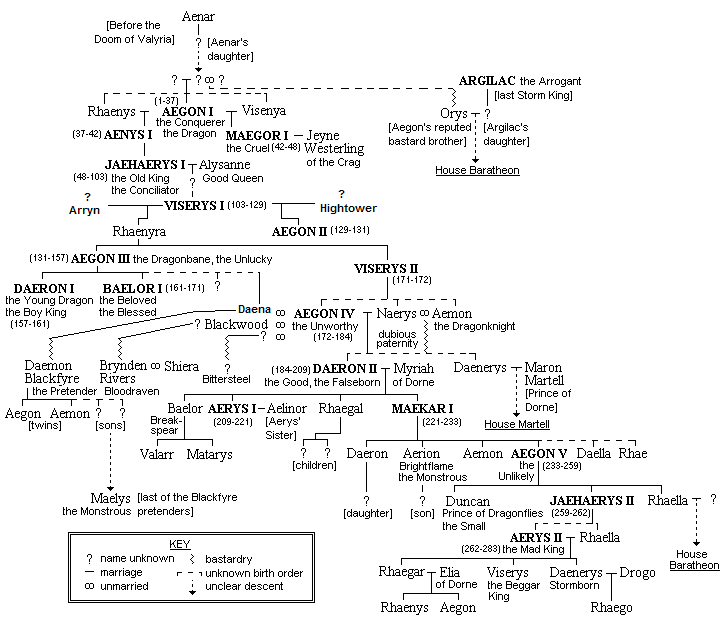
Targaryen family tree explained is one of the most searched topics in the entire Game of Thrones and House of the Dragon universe — and for good reason.
The dynasty is vast, complicated, and riddled with the kind of incestuous marriages and competing bloodlines that make casual viewers reach for a diagram.
Understanding the targaryen family tree explained in full reveals something more interesting than a list of names — it reveals a pattern of greatness and madness cycling through the same bloodline across three centuries of Westerosi history.
This is the complete guide to every major branch of the most dangerous dynasty Westeros has ever seen.
The Foundation: Aegon the Conqueror and His Sisters
The targaryen family tree explained begins with three people — Aegon I Targaryen and his two sister-wives, Visenya and Rhaenys.
Aegon arrived from Dragonstone with three dragons and united six of the seven independent kingdoms of Westeros through a combination of military genius and dragonfire.
He fathered two sons from his two wives. Aenys I was born to Rhaenys, and Maegor — later called Maegor the Cruel — was born to Visenya.
This split immediately created the first succession tension in the targaryen family tree explained, as Maegor’s brutal personality and Aenys’s weak reign set the tone for everything that followed.
The Early Kings: Jaehaerys and the Golden Age
After the chaos of Maegor’s reign, the targaryen family tree explained enters its most stable and prosperous period under Jaehaerys I — known as the Conciliator or the Old King.
Jaehaerys ruled for 55 years, the longest reign of any Targaryen monarch, and brought genuine peace and prosperity to Westeros.
He married his sister Alysanne, and together they had thirteen children — though most died before him, creating the succession crisis that opened House of the Dragon.
The Great Council of 101 AC, convened to decide his heir, passed over the female-line claim of Princess Rhaenys in favor of her cousin Viserys — a decision that planted the seeds of the Dance of the Dragons a generation later.
For more on how that succession decision worked and why it mattered so much, our Iron Throne Succession Explained article covers the full legal and political context.
Viserys I and the Split That Broke Everything
The targaryen family tree explained reaches its most consequential fork under King Viserys I.
Viserys had one child from his first wife Aemma Arryn — Rhaenyra, whom he named his heir.
He then married Alicent Hightower, who bore him four more children — Aegon, Helaena, Aemond, and Daeron.
This created two competing lines within the same immediate family. Rhaenyra’s children — Jacaerys, Lucerys, and Joffrey Velaryon, plus Aegon III and Viserys II with Daemon — represented the Black faction’s claim.
Alicent’s children — Aegon II, Helaena, Aemond, and Daeron — represented the Green faction’s counter-claim.
The targaryen family tree explained at this point is essentially a family that split itself in half and went to war.
Daemon Targaryen’s Branch
No understanding of the targaryen family tree explained is complete without tracing Daemon’s line.
Daemon was Viserys’s younger brother — a dragonrider of extraordinary skill who had previously been married to Rhea Royce and then Laena Velaryon.
With Laena he fathered two daughters — Baela and Rhaena Targaryen — both of whom became dragonriders and played significant roles in the Dance of the Dragons.
After Laena’s death, Daemon married Rhaenyra, his niece, making their children the product of two Targaryen lines simultaneously.
Their sons — Aegon III and Viserys II — both eventually became kings of Westeros after the Dance of the Dragons concluded, making Daemon’s line the one that ultimately survived and continued the dynasty.
For a full breakdown of Daemon himself, our Daemon Targaryen Explained article covers his complete story and character in depth.

The Dance of the Dragons: What It Did to the Family Tree
The targaryen family tree explained cannot avoid the Dance of the Dragons — the civil war that devastated the dynasty and reduced its power permanently.
Before the war, the Targaryens had seventeen living dragons between both factions.
By the war’s end, almost all of them were dead — killed in combat, lost at sea, or perished from wounds.
The human cost was equally catastrophic. Rhaenyra was killed by Aegon II’s dragon Sunfyre. Aegon II was poisoned shortly after. Aemond was killed by Daemon at the Gods Eye. Helaena died by suicide. Lucerys, Jacaerys, and Jaehaerys were all killed during the conflict.
The targaryen family tree explained after the Dance is a dynasty with most of its branches burned away — surviving through Aegon III and Viserys II, but permanently weakened.
For the full story of the civil war that caused this devastation, our Dance of the Dragons Explained article covers everything you need to know.
After the Dance: The Later Targaryens
The targaryen family tree explained continues after the Dance through a series of kings whose reigns grew progressively less stable.
Aegon III — Rhaenyra’s son — ruled as a traumatized young king who had witnessed his mother’s death and grew to fear dragons entirely. The last surviving dragons died during his reign.
His brother Viserys II ruled briefly and competently. His son Aegon IV — known as Aegon the Unworthy — was one of the worst kings in Westerosi history, legitimizing his bastard children on his deathbed and creating the Blackfyre pretenders whose rebellions destabilized the realm for generations.
This is the era depicted in A Knight of the Seven Kingdoms, where the legacy of Aegon the Unworthy’s legitimized bastards — the Blackfyres — creates the central political threat of Dunk and Egg’s story.
The Final Branch: Aerys II to Daenerys
The targaryen family tree explained ends — or appears to end — with the Mad King Aerys II and his children.
Aerys had three children with his sister-wife Rhaella: Rhaegar, Viserys, and Daenerys.
Rhaegar died at the Battle of the Trident fighting Robert Baratheon, but not before fathering a son with Lyanna Stark — Jon Snow, whose real name is Aegon Targaryen and who represents a surviving male-line claim to the throne.
Viserys died in Essos at Khal Drogo’s hands, leaving Daenerys as the last known Targaryen — until Jon’s true parentage was revealed.
The targaryen family tree explained at its final branch is therefore not quite extinct at the end of Game of Thrones. Jon Snow carries the blood. Whether that matters is a question the franchise has not yet fully answered.
For the full story of Jon’s Targaryen identity, our Jon Snow Explained article covers his real parentage and what it means in detail.
Why the Family Tree Matters
The targaryen family tree explained is not simply a genealogy exercise.
Every conflict in Game of Thrones and House of the Dragon connects back to a specific fork in this family tree — a succession decision, a marriage, a death, a bastard legitimized or denied.
The Targaryens built their dynasty on the idea that dragon blood and royal lineage were enough to hold power together.
The family tree itself tells the story of why that was never true — and why the same bloodline that produced Aegon the Conqueror also produced the Mad King, the Dance of the Dragons, and ultimately its own near-extinction.
Final Thought
Targaryen family tree explained ultimately reveals a dynasty defined by its contradictions.
Capable of extraordinary vision and catastrophic madness in equal measure. Bound by traditions of incest that concentrated their power and their vulnerabilities simultaneously.
The family tree is not just a diagram of who begat whom. It is a record of every choice the dynasty made about power, succession, and loyalty — and every price those choices eventually demanded.
Three hundred years of Targaryen rule left Westeros with the Iron Throne, King’s Landing, and a civilization shaped entirely by one family’s ambitions. It also left that family nearly extinct, its dragons dead, and its legacy permanently contested.
That is what the targaryen family tree explained really shows — not just a bloodline, but the full arc of what happens when a family mistakes dominance for permanence.