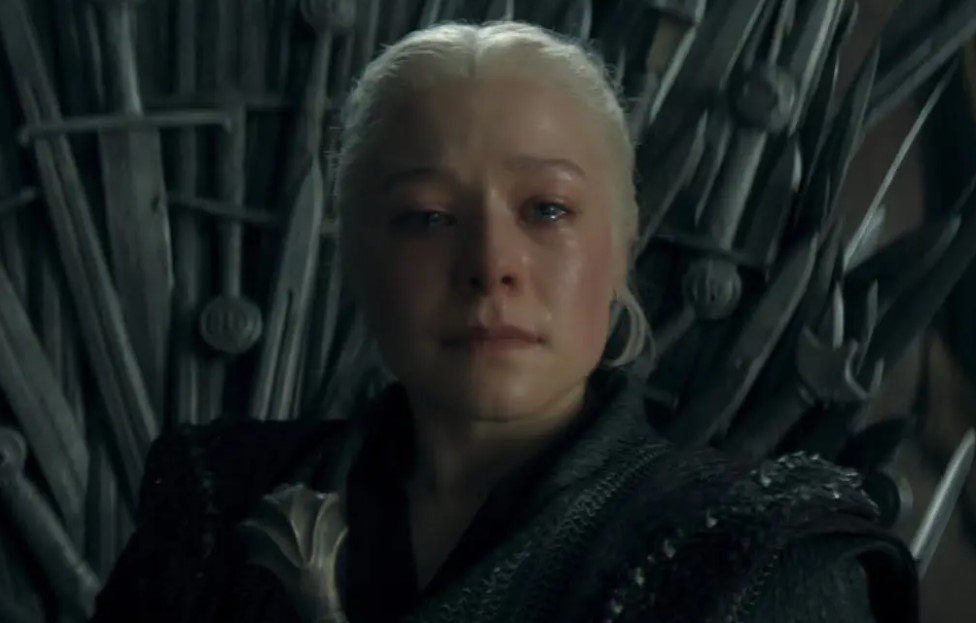
Rhaenyra’s dark turn House of the Dragon finale delivers is the culmination of a season spent chipping away at her sense of restraint, and by the time the credits roll, the queen who once agonized over difficult choices looks almost unrecognizable. This is a genuine character transformation, built carefully across eight episodes rather than arriving out of nowhere.
“I am the shield of the people. I am Rhaenyra the chosen.” — Rhaenyra, addressing King’s Landing after killing the High Septon.
Dismissing Mysaria Without Explanation
Rhaenyra’s dark turn House of the Dragon finale begins quietly, with Rhaenyra abruptly dismissing Mysaria from the castle with no real explanation given. It’s a sharp reversal from the intimacy the two shared just one episode earlier, and it signals early in the finale that Rhaenyra is retreating from anyone whose counsel leans toward caution rather than force.
Read more: Rhaenyra and Mysaria House of the Dragon: Their Kiss Explained
Force-Feeding Helaena
Rhaenyra’s dark turn House of the Dragon finale escalates dramatically once Helaena, weakened and refusing to eat out of grief and fear for her unborn child, tells Rhaenyra plainly that their father would hate what she’s become. Rather than respond with compassion, Rhaenyra has soldiers physically restrain Helaena and force food into her mouth as she thrashes and cries. It’s one of the most difficult scenes the show has produced, and it marks the point where Rhaenyra’s control over her own family crosses into open cruelty.
Read more: Alicent’s Mission to Kill Aemond in House of the Dragon Explained
Ordering the High Septon’s Death
Rhaenyra’s dark turn House of the Dragon finale reaches a genuinely shocking turning point when the High Septon refuses to publicly bless her rule, just as he refused earlier in the season. Rather than accept the refusal, Rhaenyra declares him a traitor on the spot and has Alyn kill him inside the Great Sept itself — a direct, violent assault on the religious institution she needs, at least nominally, to legitimize her claim.
Read more: Sabitha Frey Gets Harrenhal: House of the Dragon Episode 7 Explained
Declaring Herself the Prince That Was Promised
Rhaenyra’s dark turn House of the Dragon finale reaches its most theatrical moment when Rhaenyra addresses the crowd gathered outside the Great Sept, invoking her father’s public declaration of her as his successor and then going considerably further — claiming she is “the Prince That Was Promised,” a title loaded with prophetic, near-messianic weight. It’s a genuinely audacious claim, one that reframes the entire war as something closer to religious destiny than a succession dispute, and it’s delivered with a confidence that would have seemed completely foreign to the more measured Rhaenyra of Season 1.
Sending Daemon to “Kill to the Last Man”
Rhaenyra’s dark turn House of the Dragon finale also shapes the military strategy behind the Battle of Tumbleton itself. Rather than pursuing a more measured approach, Rhaenyra orders Daemon to go house-to-house through Tumbleton and “root out every Hightower, and kill them to the last man.” She adds a token caution — “do not make a monster of me” — but the instruction itself, and the scale of devastation that follows at Tumbleton, suggests the caution is more performative than genuinely restraining.
Read more: House of the Dragon Season 3 Finale Recap: The Battle of Tumbleton
The Confrontation With Baela
Rhaenyra’s dark turn House of the Dragon includes a pointed confrontation with Baela, who directly blames Rhaenyra for Corlys’s capture and accuses her of using people only when they’re useful before discarding them. Rhaenyra responds by grabbing Baela’s face and calling her an insolent child, following it with a veiled threat aimed at Baela’s sister, Rhaena. It’s a genuinely alarming escalation — Rhaenyra meeting a fair, if bluntly delivered, criticism with intimidation rather than any acknowledgment of its truth.
Why This Transformation Matters
Rhaenyra’s dark turn House of the Dragon has been building across the entire back half of the season — the empty treasury, the collapsed City Watch, the fractured marriage, the increasingly ruthless decisions like sending Alicent to kill Aemond. What changes in the finale isn’t the underlying pattern, but the scale and visibility of it. Rhaenyra is no longer making difficult private compromises; she’s making public, violent, ideological claims about her own destiny, and the people around her — Baela, Helaena, even Daemon — are increasingly treated as instruments of her rule rather than people she answers to.
House of the Dragon | Inside the Episode: Season 3 Episode 8 | HBO
FAQ
Why does Rhaenyra kill the High Septon in the finale? He refuses to publicly bless her rule, and she declares him a traitor and has Alyn kill him rather than accept the refusal.
What does Rhaenyra mean by “Prince That Was Promised”? It’s a prophetic, near-messianic title she claims for herself while addressing the crowd in King’s Landing, framing her rule as destined rather than simply inherited.
Why does Rhaenyra force-feed Helaena? Helaena refuses to eat out of grief and fear, and Rhaenyra, prioritizing the unborn child’s survival, has her physically restrained rather than addressing the underlying distress.
Does Rhaenyra show any restraint in the finale? She offers a token caution to Daemon about not making a monster of her, but her actual orders and public claims suggest that restraint is largely symbolic. Hence Rhaenyra’s dark turn House of the Dragon finale explained.
How does Baela’s confrontation with Rhaenyra end? Rhaenyra responds to Baela’s criticism with physical intimidation and a veiled threat toward her sister Rhaena, rather than any acknowledgment of the point Baela raises.