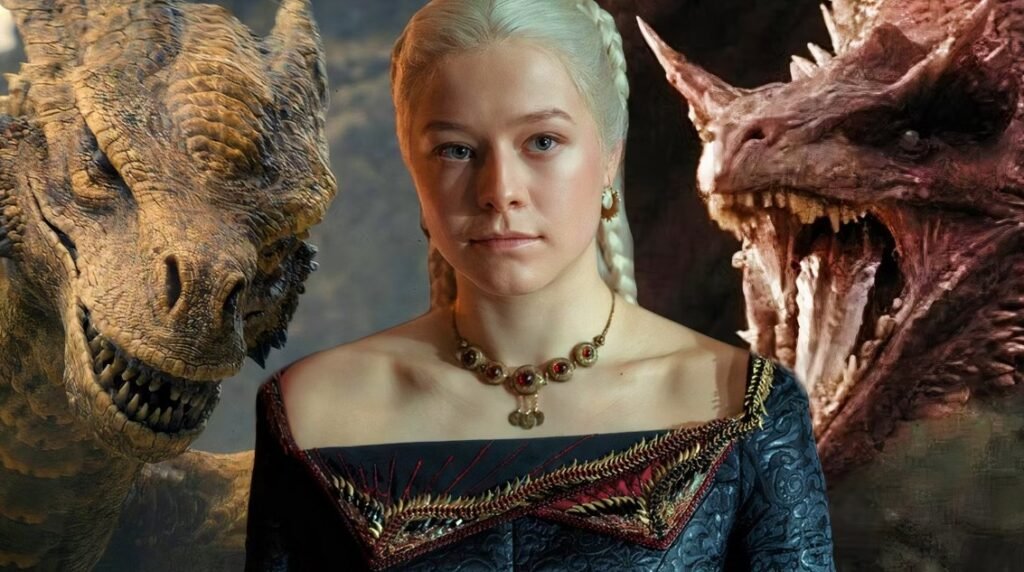

Rhaenyra Targaryen explained is essential reading for anyone watching House of the Dragon — whether for the first time or preparing for season three.
She is the center of gravity around which the entire story orbits. Every alliance, every betrayal, every dragon death, and every act of war in the Dance of the Dragons connects back to her claim and her refusal to abandon it.
Rhaenyra targaryen explained properly is not simply the story of a woman fighting for a throne. It is the story of someone who was shaped by promises that were made to her and then broken — and who spent her entire life deciding how to respond to that betrayal.
Understanding her fully changes how every scene in House of the Dragon reads.
The Promise That Started Everything
Rhaenyra Targaryen’s story begins with her father, King Viserys I.
After the death of his first wife and son in childbirth, Viserys named Rhaenyra — his only surviving child at the time — as his heir and Princess of Dragonstone.
He made the lords of Westeros swear public oaths to support her succession. He staked his reign on the legitimacy of her claim.
That promise is the foundation of everything that follows in rhaenyra targaryen explained. Every decision she makes, every war she fights, every loss she endures — all of it flows from the fact that her father made her a promise the realm refused to honor.
Rhaenyra’s Early Years: Freedom and Its Limits
As a young princess, Rhaenyra occupied an unusual position at court.
She was her father’s cupbearer and constant companion, present at Small Council meetings and given access to power that no other woman in Westeros enjoyed at the time.
She was also Alicent Hightower’s closest friend — a relationship whose eventual collapse into political rivalry is one of the most emotionally devastating arcs in the show.
Rhaenyra targaryen explained in her early years is the story of a young woman who understood power but had not yet learned its full cost. She was brilliant, willful, and entirely unprepared for how thoroughly the world would punish both qualities.
The Alicent Rupture
No element of rhaenyra targaryen explained carries more emotional weight than her broken friendship with Alicent Hightower.
When Viserys married Alicent — Rhaenyra’s closest companion — without warning, it created a fracture between the two women that political circumstances slowly transformed into open hostility.
The show is careful never to make either woman simply wrong. Alicent genuinely believed Viserys changed his mind about the succession on his deathbed. Rhaenyra genuinely believed her claim was stolen.
Both women were victims of a political system that set them against each other. Both also made choices that accelerated the conflict. That moral complexity is what makes rhaenyra targaryen explained so rich as a character study.
Dragonstone and the Black Council
After years of court conflict, Rhaenyra and her family relocated to Dragonstone — the ancestral Targaryen seat and her formal seat as Princess of Dragonstone.
When Viserys died and Alicent’s faction placed Aegon on the throne, Rhaenyra refused to accept the result.
She assembled her own council — the Black Council — at Dragonstone and began the process of mobilizing her allies, her dragons, and her claim into an active military and political challenge to the Green faction in King’s Landing.
Her decisions in those early days of the war reveal rhaenyra targaryen explained at its most strategically interesting — a ruler trying to win a civil war through diplomacy and restraint before circumstances forced her into open conflict.
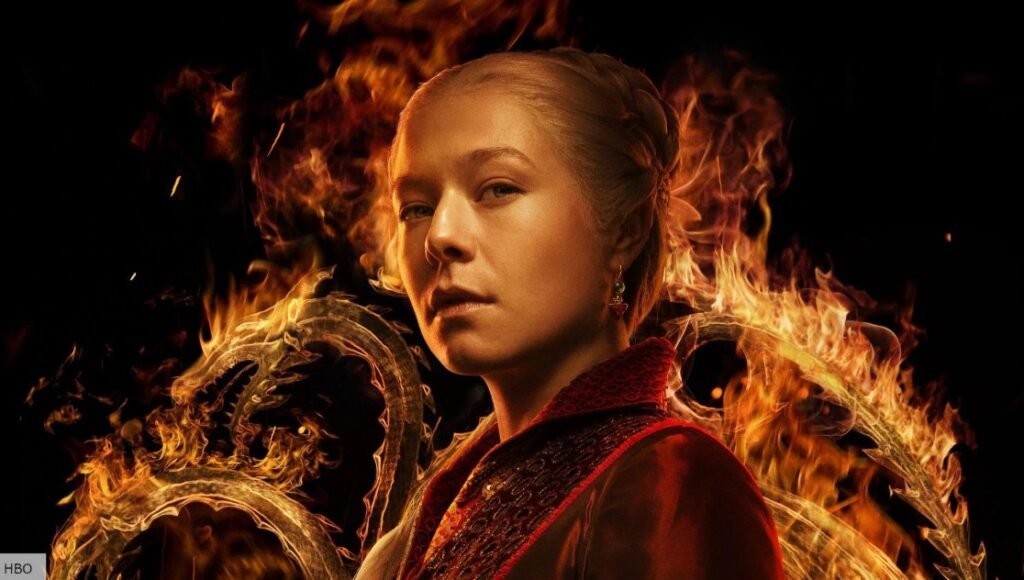
Description: Emma D’Arcy as Rhaenyra Targaryen at Dragonstone in House of the Dragon season two.
The Personal Cost of the War
Rhaenyra targaryen explained cannot ignore the devastating personal losses she absorbs across the course of the Dance of the Dragons.
She loses her son Lucerys early in the conflict — killed by Aemond and Vhagar over Shipbreaker Bay — a moment that transforms the war from a political dispute into something far more visceral and personal.
She loses allies, advisors, and dragons at a rate that steadily erodes the military advantage the Black faction held at the start of the conflict.
Each loss changes her. The Rhaenyra of season two’s later episodes is visibly different from the woman who assembled her council in episode one — harder, more isolated, and increasingly aware that the war is consuming everything she was fighting to protect.
Rhaenyra as a Ruler
One of the most interesting dimensions of rhaenyra targaryen explained is how the show portrays her as an actual ruler rather than simply a claimant.
When she briefly occupies King’s Landing in the source material — an event the show is building toward — her decisions about governance, mercy, and political management reveal both her genuine qualities as a ruler and her significant blind spots.
She is capable of genuine compassion and political vision. She is also capable of catastrophic errors of judgment, particularly when personal emotion overrides strategic calculation.
That tension — between the ruler she could be and the ruler the war is forcing her to become — is rhaenyra targaryen explained at its most compelling.
What Separates Rhaenyra From Other Claimants
Westeros has produced many rulers who fought for the Iron Throne on the basis of blood right and political ambition.
What makes rhaenyra targaryen explained distinctive is that her claim was not simply inherited — it was explicitly promised, publicly sworn, and then systematically denied by a system that changed the rules the moment her existence became inconvenient.
She did not start a war out of pure ambition. She refused to accept a theft.
That distinction matters enormously for how audiences experience her story — and it is why she remains one of the most genuinely sympathetic protagonists in the entire Game of Thrones universe, even as the war forces her into decisions that are difficult to defend.
For more on the succession system that made her claim legally valid and politically explosive, our Iron Throne Succession Explained article covers exactly how inheritance worked in Westeros and why her father’s decree should have been binding.
Rhaenyra Heading Into Season Three
As House of the Dragon season three approaches — premiering June 21, 2026 on HBO and Max — Rhaenyra’s position is both stronger and more fragile than it has ever been.
The Black faction has dragons, allies, and Daemon’s Riverlands campaign building ground support. But the personal and military losses of season two have left Rhaenyra visibly worn.
The season three trailer shows her preparing for the largest phase of the conflict yet — including the Battle of the Gullet, the devastating naval engagement that will reshape the war’s balance entirely.
For a full breakdown of what that battle involves and why it matters, our Battle of the Gullet Explained article covers everything you need to know before season three begins.
Final Thought
Rhaenyra Targaryen explained is ultimately the story of what it costs to refuse.
To refuse to accept a stolen throne. To refuse to kneel to a system that was designed to exclude her. To refuse to stop being the person her father told her she could be, even when the world punished her for it at every turn.
She is not perfect. The war she fights is not clean. The decisions she makes are not always right.
But rhaenyra targaryen explained at its deepest level is about a woman who was given a promise by the person she trusted most in the world — and who decided that promise was worth everything it cost to keep fighting for it.
That is why her story resonates. And that is why House of the Dragon, at its best, is her story above all others.