
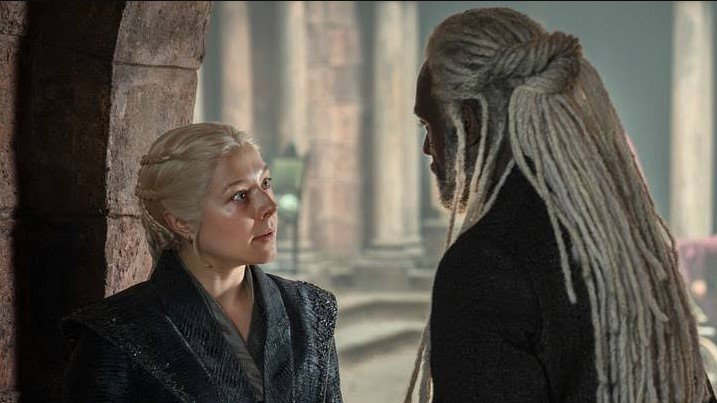
Rhaenyra refuses Velaryon name Alyn Addam Episode 3 — and it is the most revealing single political failure in “Rhaenyra Triumphant.”
Not the empty treasury. Not the rat banquet. Not the lie about Aegon’s death. The refusal to grant Corlys Velaryon’s request — to formally recognise the sons who pulled him from the water at the Gullet — is the decision that cuts deepest. Because it is not even a decision. It is an absence. A failure to respond. A queen too overwhelmed to give her most loyal ally the one thing he asked for.
And in the same episode, she knights Hugh Hammer and Ulf White.
Table of Contents
- What Corlys Asks For — and When
- Why Rhaenyra Refuses the Velaryon Name to Alyn and Addam
- The Devastating Contrast With Hugh and Ulf’s Knighting
- What Corlys Being Hand of the Queen Makes This Worse
- The Political Cost of Rhaenyra Refusing the Velaryon Name
- How This Decision Connects Directly to Tumbleton
1. What Corlys Asks For — and When
Rhaenyra refuses the Velaryon name to Alyn and Addam in Episode 3 at dinner — the wrong place, the wrong time, and entirely the right moment to understand what kind of queen she is becoming.
Corlys, freshly confirmed as Hand of the Queen, raises the matter of formal crown recognition for Alyn and Addam. He acknowledged them personally at the water’s edge in Episode 2 — an act of love made at his lowest point, with nothing left to give them but their names. What he is asking Rhaenyra for in Episode 3 is the legal counterpart: a royal decree of bastard legitimisation, giving his sons the right to carry the Velaryon name officially.
This is not an unreasonable request. It is not a politically dangerous one. It is a simple act of recognition for two men who fought for the Black faction, who saved Corlys’s life at the Gullet, and whose father is sitting at Rhaenyra’s right hand as the most senior official in her government.
Rhaenyra refuses the Velaryon name to Alyn and Addam without explanation. She looks sweaty and pale. She deflects. She moves on to the next crisis.
Rhaenyra refuses the Velaryon name to Alyn and Addam not because she has decided against it — but because she cannot hold enough in her head simultaneously to give the question it deserves. That is more damning than a deliberate refusal would be.
Read more: Alyn and Addam Acknowledged by Corlys in Episode 2: Why the Scene Changes Everything
2. Why Rhaenyra Refuses the Velaryon Name to Alyn and Addam
Rhaenyra refuses the Velaryon name to Alyn and Addam in Episode 3 because she is governing in a state of psychological fragility that makes every decision harder than it should be — and this one falls through the gap.
The episode is clear about her condition. She is hallucinating Jace in the corridors of the Red Keep. She is managing an empty treasury, a hostile High Septon, Daemon’s insistence that she kill the fake Daeron, and the accumulated weight of three seasons of war, grief, and loss. She declared Aegon publicly dead — a lie — because the truth is too politically inconvenient. She is reactive, scattered, and visibly struggling.
In that context, Rhaenyra refuses the Velaryon name to Alyn and Addam not through cruelty or political calculation — but through a failure of attention. The request lands in a moment she cannot process it. She does not engage. She moves on.
This is the specific and uncomfortable quality of “Rhaenyra Triumphant” as a governing portrait. She is not making bad decisions. She is failing to make decisions at all — letting relationships deteriorate and requests go unanswered because the throne she fought for is producing more complexity than she currently has the capacity to manage.
Read more: House of the Dragon Season 3 Episode 3 Recap: Rhaenyra Triumphant
3. The Devastating Contrast With Hugh and Ulf’s Knighting
Rhaenyra refuses the Velaryon name to Alyn and Addam in Episode 3 — and in the same episode, she knights Hugh Hammer and Ulf White.
This contrast is the episode’s most pointed piece of political irony, and the show stages it with full awareness of what it is doing. Hugh Hammer and Ulf White abandoned their post. Daemon had to slap Ulf to express his displeasure. Neither man has demonstrated the kind of loyalty that earns formal royal recognition — and yet both receive it. Ser Hugh. Ser Ulf the White — after Ulf’s bid to call himself “Ulf Targaryen” is flatly refused.
Alyn and Addam receive nothing from the crown in Episode 3. They fought at the Gullet. Alyn killed Sharako Lohar — the man who nearly killed Corlys. Addam found Corlys in the water and brought him back. Their father is her Hand of the Queen. And Rhaenyra refuses the Velaryon name to Alyn and Addam while granting formal recognition to the two men who will eventually betray her above a burning town.
The show is not being subtle. The men she rewards will burn Tumbleton. The men she ignores will die staying loyal. Rhaenyra refuses the Velaryon name to Alyn and Addam — and that refusal is the episode’s clearest window into the specific mechanism by which her reign begins destroying itself.
Read more: Hugh Hammer and Ulf White Abandon Post: What Their Disappearance Means for Season 3
4. What Corlys Being Hand of the Queen Makes This Worse
Rhaenyra refuses Velaryon name Alyn Addam Episode 3 while Corlys is sitting at the table as her Hand of the Queen — and that specific context makes the refusal considerably more damaging than it would otherwise be.
Being appointed Hand is the highest formal honour in Rhaenyra’s government. It signals that she trusts Corlys above everyone else with the daily administration of her reign. She has given him the most powerful position available to someone who is not the monarch.
And then she cannot give him the one thing he asked for his sons.
Rhaenyra refuses the Velaryon name to Alyn and Addam in the presence of the man she just made her most senior official — a man who has sacrificed his fleet, his castle, his physical safety, and his sons’ futures to her cause across three seasons. The refusal, in that context, reads not just as governance failure but as a specific kind of ingratitude that the show frames with precision.
Corlys’s fury is immediate, visible, and completely justified. He does not storm out. He does not threaten to resign. But the anger is real and contained — the anger of a man who has given everything and is watching the person he gave it to fail to meet the most basic obligation of a ruler to her most loyal ally.
Read more: Rhaenyra’s Small Council in Occupied King’s Landing: Who Is Advising the Queen Now?
5. The Political Cost of Rhaenyra Refusing the Velaryon Name
Rhaenyra refuses Velaryon name Alyn Addam Episode 3 — and the political cost accumulates in multiple directions simultaneously.
The most immediate cost is Corlys’s fury. The man who runs her naval strategy, who commands the loyalty of her most experienced fleet commanders, who knows where every ship in her navy is positioned — that man is now sitting at her table angry about something she could have resolved with a sentence.
The broader cost is the signal it sends about her governance. Rhaenyra refuses the Velaryon name to Alyn and Addam while the city watches for signs of what kind of queen she is. A queen who cannot deliver basic recognition to the sons of her most loyal commander, who can manage a symbolic rat banquet but not a simple political favour — that queen is telling her court something about the gap between her intentions and her capacity.
The smallest and most personal cost is what Alyn and Addam themselves experience. They were acknowledged at the water’s edge by their father at his lowest point. They have now been denied the crown’s recognition by the queen their father serves. The acknowledgement that meant everything in Episode 2 has not been matched by anything official in Episode 3. They are still technically Hull bastards carrying a dead lord’s informal word.
Rhaenyra refuses Velaryon name Alyn Addam Episode 3 — and every consequence of that refusal will still be running through the season when Addam dies above Tumbleton staying loyal to a queen who would not give him his name.
Read more: Addam of Hull After Episode 2: What His Acknowledgement Means for Tumbleton and Beyond
6. How This Decision Connects Directly to Tumbleton
Rhaenyra refuses Velaryon name Alyn Addam Episode 3 — and the show is building that refusal into the Tumbleton arc with deliberate structural precision.
At the First Battle of Tumbleton, Hugh Hammer and Ulf White — the freshly knighted Sers — turn their dragons against Rhaenyra’s forces. They betray. Addam of Hull, flying Seasmoke, fights against them. He stays loyal. He and Seasmoke die above the burning town, loyal to a cause that formally recognised Hugh and Ulf while leaving Addam without the Velaryon name he was promised.
The contrast the show is building is explicit: recognition does not produce loyalty, and loyalty does not require recognition. But the specific cruelty of Rhaenyra refusing the Velaryon name to Alyn and Addam — while rewarding the men who betray her — is the show’s most pointed statement about the specific mechanism of her reign’s failure.
She gave Hugh and Ulf titles they did not earn. She refused Alyn and Addam a name they were owed. The man who earned nothing and got a knighthood burned Tumbleton. The man who was owed a name and never received it died defending it.
Rhaenyra refuses Velaryon name Alyn Addam Episode 3. That refusal costs her Tumbleton. The accounting runs across the season’s remaining five episodes — and Addam of Hull pays it for her.
House of the Dragon | Episode 4 Preview | HBO Max
FAQ: Rhaenyra Refuses Velaryon Name Alyn Addam Episode 3
Why does Rhaenyra refuse the Velaryon name to Alyn and Addam in Episode 3?
Rhaenyra refuses Velaryon name Alyn Addam Episode 3 not through deliberate political decision but through a failure of attention — she is governing while psychologically overwhelmed by grief, the empty treasury, the High Septon’s refusal to crown her, and hallucinations of Jace. Corlys’s request falls through the gap between the crises she is actively managing.
What does Corlys ask Rhaenyra for in Episode 3?
Corlys asks Rhaenyra to officially legitimise Alyn and Addam as his sons and grant them the right to carry the Velaryon name — a formal royal decree distinct from his personal acknowledgement at the water’s edge in Episode 2.
Why is it significant that Rhaenyra refuses Velaryon name Alyn Addam Episode 3 while knighting Hugh and Ulf?
The contrast is the episode’s most pointed political irony. Hugh and Ulf abandoned their post and received formal knighthoods. Alyn and Addam saved Corlys at the Gullet and received nothing. The men formally recognised in Episode 3 will betray Rhaenyra at Tumbleton. The men denied recognition will die staying loyal.
Does Corlys become Hand of the Queen in Episode 3?
Yes — Corlys is confirmed as Hand of the Queen in Episode 3, making Rhaenyra’s simultaneous refusal of his request for Alyn and Addam’s recognition even more politically significant.
Does Rhaenyra eventually give Alyn and Addam the Velaryon name?
This has not been confirmed beyond Episode 3. Whether she returns to the matter — and whether Corlys presses it again — is one of the season’s ongoing threads.
How does Rhaenyra refusing the Velaryon name to Alyn and Addam connect to the Battle of Tumbleton?
At the First Battle of Tumbleton, Addam of Hull stays loyal to Rhaenyra and flies Seasmoke against the betrayers Hugh and Ulf — dying for a cause that formally recognised his betrayers while denying him the name his father requested on his behalf. The show is building that contrast deliberately across Episodes 2, 3, and the upcoming Tumbleton engagement.
The Name She Would Not Give
Rhaenyra refuses Velaryon name Alyn Addam Episode 3 — and the refusal will matter more than almost anything else she does in “Rhaenyra Triumphant.”
She knighted the men who will burn Tumbleton. She denied the name to the man who will die there staying loyal.
Rhaenyra refuses Velaryon name Alyn Addam Episode 3 — and that accounting is still running. Five episodes remain. Tumbleton is coming.