
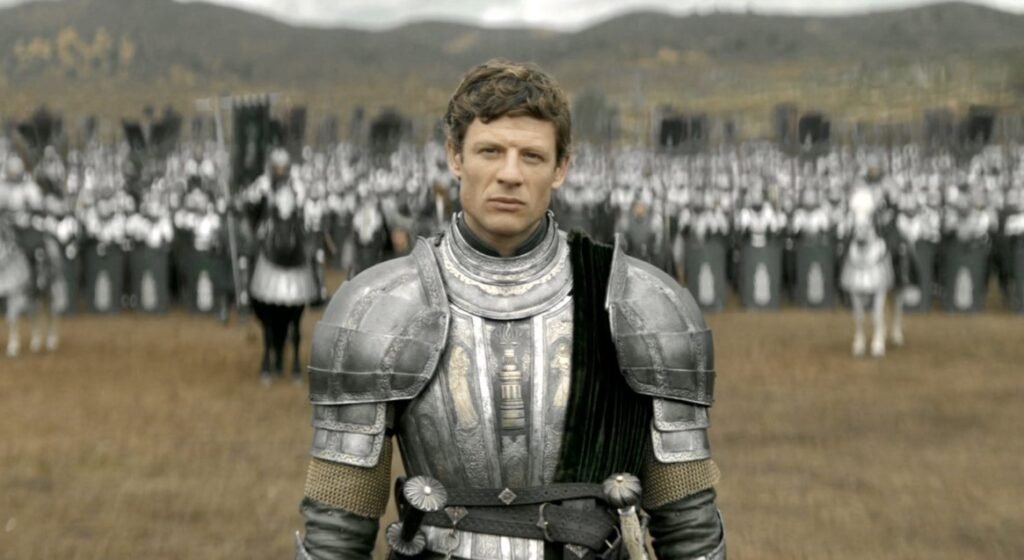
Ormund Hightower’s weakness in Season 3 — his sharp sensitivity to strong odours — was planted in Episode 4 with the careful reverence that House of the Dragon reserves for details it intends to use later, and the question worth asking now is exactly what Rhaenyra is going to do with it.
Ormund Hightower’s weakness reached Rhaenyra through Alicent, in the scene where she asked the most personal question she could think to ask about the man who has turned Tumbleton into a Green stronghold. Alicent barely knows him. But she remembers the smell thing.
That detail is sitting in the show now, ticking quietly, waiting for the episode that deploys it.
Table of Contents
- How Rhaenyra Learned About Ormund’s Weakness
- What a Sensitivity to Odours Actually Means in a Medieval War
- Whether This Is Chekhov’s Gun or Simply Character Detail
- The Tumbleton Problem and Why Rhaenyra Needs a Non-Dragon Solution
- What Alicent’s Cooperation Reveals About Her Own Position
- When and How the Weakness Might Be Used
How Rhaenyra Learned About Ormund’s Weakness
Ormund Hightower’s weakness reached Rhaenyra in Episode 4 through the most unlikely intelligence channel available to her — a conversation with the woman whose father she executed on the first day of her reign.
Rhaenyra went to Alicent for whatever she could learn about Ormund. Alicent, she knew, had grown up adjacent to the Hightower family without being particularly close to its more distant cousins. Alicent’s response was honest and specific: she barely knew the man, but she remembered a few things. He was a scholar. He collected tapestries. And he had a peculiar, sharp sensitivity to odours.
Ormund Hightower’s weakness was not offered as strategic intelligence. Alicent did not know it would be useful. She was simply answering a question about a relative she had spent limited time with, picking at the anxious skin around her fingers as she spoke — an old tic Rhaenyra noticed without commenting on.
The show handles the detail with deliberate restraint. No one in the scene reacts to it as if it matters. The camera does not linger. It passes and moves on. That restraint is the tell. When television treats information that way, it means the information is coming back.
“The Scraps from the Loft review described the moment with the precision of a writer who has spent time around storytellers: the show handled the intelligence ‘with such reverent care — such a hush — that you can practically hear the writers whispering, remember this, this is his exhaust port, this is how the Death Star comes down.'”
Read more: House of the Dragon Season 3 Episode 4 Recap: Tumbleton — Every Major Scene Broken Down
What a Sensitivity to Odours Actually Means in a Medieval War
Ormund Hightower’s weakness in Season 3 requires understanding what it would actually mean to have a sharp sensitivity to odours in a medieval military context — because the options for deploying that weakness are more varied than they might initially appear.
A medieval army at war smells. Permanently, overwhelmingly, without remedy. Latrines, horse dung, burning wood, unwashed men, cooking fires, blood, disease — the olfactory landscape of a military encampment is one of its defining features. Ormund’s 15,000 soldiers have been quartered in Tumbleton. They have been there long enough to produce everything a military occupation produces in terms of smell.
Ormund Hightower’s weakness therefore exists in an environment that is already assaulting it constantly. The question is not whether Rhaenyra can expose him to bad smells — it is whether she can deploy something specific enough to incapacitate him at a moment that matters.
Wildfire is the immediate thought, and not an implausible one. Wildfire produces a distinctive, acrid smell alongside its characteristic green flame. Its use within a town like Tumbleton — where Rhaenyra cannot simply send dragons without burning civilians who raised her banners — would create exactly the kind of olfactory chaos that a man with Ormund’s specific sensitivity might find uniquely unbearable.
There are softer options too. A negotiation conducted in proximity to something Ormund cannot tolerate. An assassination attempt built around disrupting his senses. A siege tactic that uses his weakness as a force multiplier without requiring direct confrontation.
Read more: Daeron Tumbleton Season 3 Episode 3 Reveal: What It Changes for House of the Dragon Season 3
Whether This Is Chekhov’s Gun or Simply Character Detail
Ormund Hightower’s weakness in Season 3 is being treated by most viewers as a Chekhov’s Gun — the storytelling principle that any weapon introduced must eventually be fired. But it is worth asking whether it might simply be a character detail rather than a plot mechanism.
The Chekhov’s Gun reading: Alicent volunteered this information specifically to Rhaenyra, specifically in the context of a strategic discussion about how to deal with Ormund. The show treated it with restraint that signals significance. The Battle of Tumbleton — which must happen in the next three or four episodes — needs Rhaenyra to engage with Tumbleton somehow. Ormund Hightower’s weakness gives her a non-dragon option she did not have before.
The character detail reading: the show has demonstrated across three seasons that it sometimes plants character specifics simply to make figures feel real rather than plot-functional. Ormund is described as a scholar who collects tapestries. The tapestry detail has not been plot-functional. The odour sensitivity may occupy the same category — something that makes him a three-dimensional eccentric rather than a weapon the show is loading.
The balance of evidence favours the Chekhov’s Gun reading. Alicent’s information about the tapestries was delivered casually. The odour detail was delivered with the reverence the Scraps review identified precisely. That tonal distinction is meaningful. The show wants you to remember Ormund Hightower’s weakness. It does not want you to remember his tapestry collection.
Read more: Ormund Hightower and Daeron’s Southern March in House of the Dragon Season 3: The War’s Next Front
The Tumbleton Problem and Why Rhaenyra Needs a Non-Dragon Solution
Ormund Hightower’s weakness in Season 3 matters most in the context of a specific strategic problem Rhaenyra articulated in Episode 4 — she cannot simply send dragons to Tumbleton.
Tumbleton raised her banners. It is her town, politically speaking, even under Ormund’s occupation. If she sends Syrax or Caraxes to burn Tumbleton, she burns her own supporters, creates a propaganda disaster, and validates every piece of “Rhaenyra the Cruel” graffiti currently being chalked on King’s Landing’s walls. She cannot do what she would do if Tumbleton were simply a Green faction stronghold with no civilian complications.
Ormund Hightower’s weakness therefore exists within a strategic constraint that makes the non-dragon solution particularly valuable. Whatever Rhaenyra does about Tumbleton has to either minimise civilian casualties or produce a sufficiently decisive result fast enough that the propaganda damage can be managed. An intelligence-based solution that targets Ormund specifically — rather than the town he has occupied — is the kind of outcome that Rhaenyra’s current political position almost requires.
The armies coming from the Riverlands, which the Small Council decided to redirect toward Tumbleton in Episode 4, provide ground forces. Ormund Hightower’s weakness provides a potential edge. The question is whether Rhaenyra can connect those two things before the First Battle of Tumbleton determines whether the connection matters.
Read more: Rhaenyra’s Paranoia in Season 3: Why Emma D’Arcy Says Episode 4 Makes It Official
What Alicent’s Cooperation Reveals About Her Own Position
Ormund Hightower’s weakness reached Rhaenyra because Alicent chose to share it — and that choice is worth examining independently of the intelligence itself.
Alicent, sitting across from the woman who executed her father, chose to be helpful. She offered what little she knew. She did not withhold the odour detail, did not use it to negotiate better treatment for herself or Helaena, did not frame it as leverage. She simply gave Rhaenyra what she had.
This is consistent with the Alicent the show has been building across three seasons — a woman who is exhausted by the game and increasingly willing to simply tell the truth rather than play the angle. She said it herself in Episode 4: sending Daeron to Oldtown was probably her truest act of motherhood. She is done performing loyalty to a faction that destroyed her family. Sharing Ormund Hightower’s weakness is not alliance. It is the action of someone who has stopped caring which side wins and started caring only about the people she has left.
That does not make her Rhaenyra’s ally. But it makes her something more interesting than her enemy — a person who will occasionally do the useful thing simply because it is the true thing, without any calculation about what it earns her.
Read more: Helaena and Alicent in the Occupied Red Keep: Why Their Relationship Is Season 3’s Most Devastating
When and How the Weakness Might Be Used
Ormund Hightower’s weakness in Season 3 is most likely to surface in Episode 5 or 6, depending on when the First Battle of Tumbleton arrives and what role Rhaenyra plays in its strategy.
If the show uses Ormund Hightower’s weakness as a plot mechanism, the most elegant deployment would be during the battle itself — something that disrupts his command at the moment the betrayal of Hugh and Ulf also disrupts his military situation. The combination of internal chaos from the dragonseed treachery and personal incapacitation from his odour sensitivity would make for a battle commander who is losing his forces and his senses simultaneously.
Ormund Hightower’s weakness could also be used in a more intimate setting — a pre-battle meeting or negotiation where Rhaenyra sends an envoy with something specifically designed to compromise him. This would be the subtler deployment, the one more consistent with the show’s approach to Alicent’s intelligence — something that nudges an outcome rather than determines it.
What is clear is that the show planted Ormund Hightower’s weakness with intention. The Tumbleton storyline has four episodes to resolve. The weakness has been loaded. At some point between now and the finale, it fires.
House of the Dragon | Episode 5 Preview | HBO Max
FAQ: Ormund Hightower Weakness Odour Season 3
What is Ormund Hightower’s weakness in House of the Dragon Season 3?
Ormund Hightower’s weakness in Season 3 is a sharp sensitivity to strong odours — revealed by Alicent to Rhaenyra in Episode 4 when Rhaenyra asked Alicent what she remembered about her cousin.
How did Rhaenyra learn about Ormund Hightower’s weakness?
Rhaenyra asked Alicent directly for whatever she could remember about Ormund. Alicent, who barely knew him, recalled that he was a scholar, collected tapestries, and had a peculiar sensitivity to strong smells. She shared this without strategic framing — simply answering honestly.
Is Ormund’s odour sensitivity going to be used as a plot point?
The show treated the detail with deliberate reverence — the kind of careful staging that House of the Dragon reserves for information it intends to deploy later. The Tumbleton storyline has several episodes remaining. The balance of evidence strongly suggests Ormund Hightower’s weakness will be used as a plot mechanism rather than simply character texture.
Why can’t Rhaenyra just send dragons to Tumbleton?
Tumbleton raised Rhaenyra’s banners — burning it with dragons would destroy her own civilian supporters, create a propaganda catastrophe, and validate the “Rhaenyra the Cruel” narrative. She explicitly acknowledged in Episode 4 that she cannot march in without burning her own people. Ormund Hightower’s weakness provides a potential non-dragon solution to a problem that dragons cannot cleanly solve.
What does Alicent sharing Ormund’s weakness reveal about her?
It reveals a woman who has stopped playing the political game and started simply telling the truth. She shared the intelligence without negotiating anything for herself in return — consistent with an arc about exhaustion with performance and the slow abandonment of the faction she helped build.
When might Ormund Hightower’s weakness be used in Season 3?
Based on narrative pacing, Ormund Hightower’s weakness is most likely to be deployed during the First Battle of Tumbleton — expected in Episode 5 or 6 — either as a command-level disruption during the battle or as part of a pre-battle strategic approach.
The Exhaust Port Is Identified. Now Someone Has to Hit It.
Ormund Hightower’s weakness in Season 3 is sitting in the show now, waiting. Rhaenyra has the information. Tumbleton has the problem. Episode 5 has the opportunity.
The show planted the odour detail quietly and moved on. That is always the sign it matters. Ormund Hightower’s weakness will be back. The only question is what form the deployment takes.
July 19. Four episodes remain.