
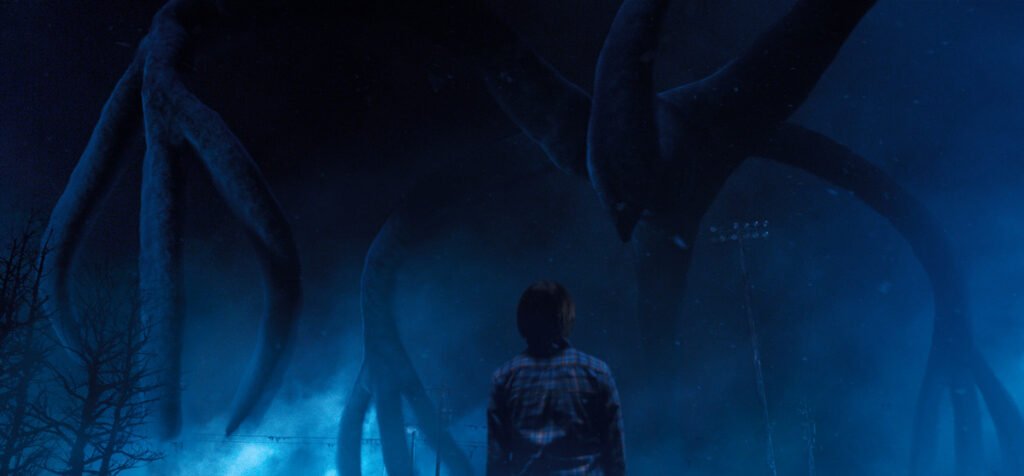
The Demogorgon’s design looks like pure computer animation in a lot of its most memorable scenes, but for much of Stranger Things’ first season, the creature stalking Hawkins was something far more old-fashioned: a contortionist in an elaborate practical suit, built by the same effects house responsible for the Hellboy films.
Table of Contents
- Who designed the Demogorgon’s look
- The artistic influences behind the creature
- How the practical suit and CGI worked together
- The actor who brought the Demogorgon to life
- Frequently asked questions about the Demogorgon’s design
Who designed the Demogorgon’s look
The Demogorgon’s design began with concept artist Aaron Sims, who the Duffer Brothers recruited to finalize the creature’s appearance after early development work. Once Sims and his team — including artists Joshua Min, Nattawut Baiphowongs, Steffen Reichstadt, Jared Krichevsky, Tsvetomir Georgiev, Daniel Edery, and Mikhail Rakhmatullin — had settled on a design, the practical build was handed to Spectral Motion, the effects studio owned by prosthetic makeup designer Mike Elizalde, known for their work on Pacific Rim, Birdman, and the Hellboy franchise. Spectral Motion constructed both a wearable costume for on-set performance and a separate animatronic head capable of more detailed facial movement than a suit alone could manage.
Sims has described the design process as a genuine engineering challenge as much as an artistic one — the team had to reverse-engineer how a performer could actually wear and move within the creature’s elaborate petal-shaped head while still keeping the design recognizably humanoid enough to feel relatable as a physical threat within the show’s world.
The artistic influences behind the creature
The Demogorgon’s design draws from a specific set of artistic touchstones the Duffer Brothers were drawn to. Sims has cited the “fantastical elements” of Guillermo del Toro and the “hellish quality” of Clive Barker’s work as key references, alongside a heavy dose of H.R. Giger’s biomechanical horror aesthetic, particularly its distinctly 1980s sensibility that lined up with the show’s period setting.
For the Upside Down itself, Sims found more specific inspiration in an unexpected source: the paintings of Polish artist Zdzisław Beksiński, whose unsettling, decayed imagery gave the dimension its hellish texture. The Duffers themselves have pointed to “Alien” and the video game “Silent Hill” as broader inspirations for how the Upside Down mirrors the real world — the same way Alien’s eggs altered their surroundings, Sims built the Upside Down as a kind of membrane laid directly over familiar Hawkins locations.
“We had to show another world reaching into ours, and those shots had to be fully VFX,” Sims said of translating the design into the show’s most dimension-spanning moments.
How the practical suit and CGI worked together
The Demogorgon’s design wasn’t purely practical or purely digital — the show blended both approaches depending on what a given scene required. Sims has explained that full CGI was reserved specifically for moments an actor in a physical suit simply couldn’t perform, particularly supernatural sequences like the creature breaking directly through walls between dimensions, where no practical rig could achieve the same effect.
Everyday appearances of the creature, by contrast, leaned heavily on the practical suit and animatronic head built by Spectral Motion. Even a scene as small as the Demogorgon’s brief daylight appearance darting past Nancy near the pool was handled as a practical, on-set consideration rather than requiring any additional visual effects work from Sims’ team — a reminder that even in a show built around an interdimensional monster, plenty of its scares came down to old-fashioned suit performance rather than a computer.
The actor who brought the Demogorgon to life
Mark Steger served as the on-set performer for the Demogorgon, wearing the practical suit for a role that demanded real physical endurance — Steger performed much of his work on stilts, with restricted vision inside what amounted to a sensory-deprivation-style costume, while still delivering the creature’s distinctive, unsettling physicality. Steger came to the role with genuine experience in monster performance, having previously played the “Quadruped Alien” in “Men in Black II” among other creature roles across his career.
Steger has spoken about the experience in personal terms, telling Bloody Disgusting that playing the Demogorgon “helped me remember why I loved film” — a notable reflection given how physically demanding the role clearly was. The creature’s design would go on to directly influence the show’s later monsters as well; when the production team built Vecna for season 4, they deliberately chose an almost entirely practical-effects approach for that character too, wanting the villain to carry the same kind of tangible, human presence the Demogorgon’s suit-based performance had established years earlier, even though Vecna’s specific design drew more directly from “A Nightmare on Elm Street” and, by some accounts, “Game of Thrones'” Night King.
For more on how the Demogorgon’s design evolved into the show’s other Upside Down creatures, Read more: Demogorgon vs Demodog vs Demobat breaks down how each variant differs. And for the villain whose own practical-effects design followed a similar philosophy, Read more: Vecna’s True Identity covers Henry Creel’s full transformation.
ScreenRant’s behind-the-scenes coverage of Spectral Motion’s practical effects work goes deeper into the suit’s construction, and it’s worth reading in full here.
Stranger Things 5 | Official Trailer | Netflix
Frequently asked questions about the Demogorgon’s design
Who designed the Demogorgon in Stranger Things? The Demogorgon’s design was created by concept artist Aaron Sims and his team, with the physical suit and animatronic head built by effects studio Spectral Motion, known for their work on the Hellboy films.
Is the Demogorgon a practical effect or CGI? Both. The Demogorgon’s design combines a practical suit worn by performer Mark Steger for most scenes with CGI reserved specifically for supernatural moments a physical suit couldn’t achieve, like breaking through walls between dimensions.
Who played the Demogorgon in Stranger Things? Contortionist and actor Mark Steger performed as the Demogorgon on set, wearing the practical costume while working on stilts with limited visibility inside the suit.
What inspired the Demogorgon’s design? The Demogorgon’s design drew on influences including Guillermo del Toro, Clive Barker, H.R. Giger, and the paintings of Polish artist Zdzisław Beksiński, along with broader inspiration from “Alien” and the video game “Silent Hill.”
Did the Demogorgon’s design influence later Stranger Things monsters? Yes. The production team’s commitment to practical effects for the Demogorgon directly influenced their approach to Vecna in season 4, which was also built almost entirely through practical prosthetics rather than CGI.