
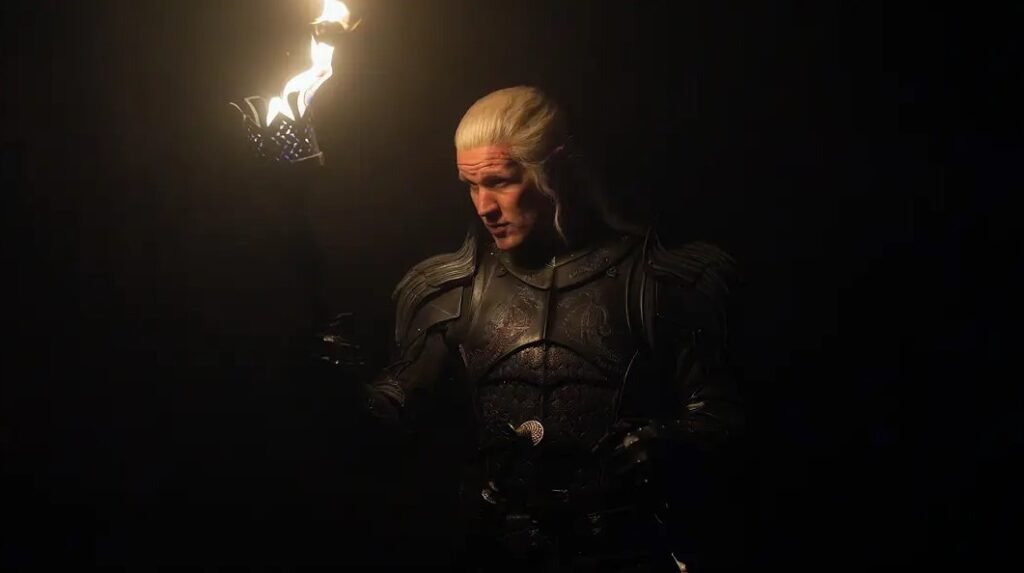
The Daeron Targaryen and Ormund Season 3 character change is the most discussed book departure in Episode 4, and the conversation around it reveals something important about what the show is attempting with the character it kept hidden for two full seasons.
In Fire and Blood, Daeron Targaryen earns the nickname “Daeron the Daring.” He is a young prince who rides into battle with genuine courage, earns the admiration of his commanders, and fights alongside his dragon in a way that distinguishes him from both his reckless brother Aegon and his calculating brother Aemond. He is, in the most straightforward sense, the best of Alicent’s sons.
The Daeron Targaryen and Ormund Season 3 character change places him under a man who smashes his sword into tables when he does not get what he wants, who forced the boy to execute a civilian as proof of readiness, and who sees him primarily as a Hightower prince rather than a Targaryen one. Whether the show is building toward “Daeron the Daring” through the darkness of Ormund’s influence, or diverging from that destination entirely, is the question Episode 4 raised and has not yet answered.
Table of Contents
- Who Daeron Is in Fire and Blood — and How Different That Is From What We Are Seeing
- What Ormund Is Actually Doing to Daeron
- The Civilian Execution Scene and What It Costs Him
- Why the Show May Have Chosen This Path
- Whether Daeron Can Still Become Who He Was Always Supposed to Be
- What Benjamin Evan Ainsworth Is Bringing to the Role
Who Daeron Is in Fire and Blood — and How Different That Is From What We Are Seeing
The Daeron Targaryen and Ormund Season 3 character change requires starting from what Fire and Blood established, because the gap between that Daeron and the one appearing on screen is the specific thing worrying book readers.
In George R.R. Martin’s source material, Daeron is characterised as brave, capable, and well-liked by the commanders he serves alongside. His nickname “Daeron the Daring” is earned in combat — he flies Tessarion into battle with a decisiveness that his brothers, for all their flaws, match only through violence rather than genuine military courage. He is not naive. He is not a pushover. He is simply a young man who was raised away from the Red Keep’s specific dysfunction and emerged from that distance without his brothers’ specific damage.
The Daeron Targaryen and Ormund Season 3 character change from this baseline is significant. The boy standing next to Ormund in Episode 4 is passive, uncertain, and reluctant. He warned away another serving boy when Ormund’s rage began building, which tells us he has grown up with that rage as a constant environmental feature. He did not want to kill Janos. He killed him anyway. He watches Ormund’s tantrums with the practiced stillness of someone who has learned when to make himself invisible.
That is not “Daeron the Daring.” Whether it becomes him is the question.
Read more: Daeron Targaryen Season 3 Episode 3 Debut: What His First Scene Tells Us About His Arc
What Ormund Is Actually Doing to Daeron
The Daeron Targaryen and Ormund Season 3 character change is not accidental within the show’s framing — Ormund is consciously and deliberately shaping Daeron into a specific kind of king, and Episode 4 showed us exactly what that process looks like.
Ormund wants Daeron to be king. He said so explicitly in Episode 4. But his version of kingship is defined by the specific Hightower worldview he articulated in the bath — the Targaryens and their blood magic have been in the way of what was rightfully the Hightowers’. Now there is a chance to do it differently. He wants to weed out feebleness in the boy. He wants someone who will do what kings have to do without flinching.
The Daeron Targaryen and Ormund Season 3 character change is therefore Ormund’s project as much as Daeron’s arc. He is not simply keeping the prince safe in Tumbleton. He is making a king out of him — or trying to. The civilian execution was the test. The reluctance Daeron showed before complying was the thing Ormund most needed to eliminate.
What the show is doing with this is raising a question it will spend the next four episodes answering: is Ormund building Daeron into something better than his brothers, or worse? Is the reluctance he is trying to eliminate the flaw Daeron needs to lose, or the quality that makes him different from Aegon and Aemond?
Read more: How House of the Dragon Season 3 Is Setting Up Rhaenyra’s Fall: Why the Signs Are Everywhere
The Civilian Execution Scene and What It Costs Him
The Daeron Targaryen and Ormund Season 3 character change is most visible in the scene the Winter is Coming review called “the change I enjoyed the least” — Ormund ordering Daeron to kill Janos, the civilian he had appeared to pardon.
Daeron did not want to do it. The show makes that clear. He is not cruel by nature. He did not draw the blade eagerly. He complied — and the body was burned by Tessarion, which is its own kind of horror, the dragon he has spent quality time with in the episode being used as a disposal mechanism rather than a companion.
The Daeron Targaryen and Ormund Season 3 character change registered in that execution is specific: Daeron is being trained to override his own reluctance. Not to feel no reluctance — Ormund is realistic enough to know that cannot be done in a single lesson — but to act regardless of it. The first time is always the worst. Now Daeron knows he can do it.
What that knowledge costs him, and what it produces in him going forward, is the character question the show is building toward. Fire and Blood’s Daeron the Daring never had this moment — never had to prove himself by killing a man he had already spared. Whether the show’s version of his courage is better or worse for having paid this price is a question Episode 5 and 6 will need to begin answering.
Read more: House of the Dragon Season 3 Episode 4 Fan Reactions: A Slow Episode That Planted Everything
Why the Show May Have Chosen This Path
The Daeron Targaryen and Ormund Season 3 character change is a deliberate creative choice, and there are legitimate storytelling reasons for it even if book readers find the departure frustrating.
The simplest reason: the show needed Ormund to be a villain with texture, not simply a military commander. Giving him a relationship with Daeron that is genuinely troubling — the manipulation, the rage, the execution as hazing ritual — makes him a more interesting antagonist than a capable but conventional general. His relationship with Daeron becomes the show’s vehicle for examining what Hightower power actually looks like when it has the opportunity to shape a king without Targaryen court interference.
The Daeron Targaryen and Ormund Season 3 character change also serves a narrative function around comparison. The show has now given us Daeron’s arc as a counterpoint to both his brothers’ formation. Aegon was raised in the Red Keep’s entitlement and dysfunction. Aemond was raised in the Red Keep’s shadow and cruelty. Daeron was raised by Ormund — a man whose affection is expressed through pressure, whose version of love is the removal of weakness. None of these formations are healthy. The show seems interested in asking which one produces the least damage.
Read more: Daeron Tumbleton Season 3 Episode 3 Reveal: What It Changes for House of the Dragon Season 3
Whether Daeron Can Still Become Who He Was Always Supposed to Be
The Daeron Targaryen and Ormund Season 3 character change does not necessarily mean the show has abandoned “Daeron the Daring” as a destination — it may simply be taking a longer and darker road to get there.
There are two possible trajectories from what Episode 4 established. In the first, Daeron’s compliance with the execution is the low point — the moment before something changes in him, before he finds a resource in himself that Ormund’s manipulation did not produce and cannot take away. The courage that earns him his nickname in the source material arrives not because Ormund built it into him but despite Ormund’s specific version of kingmaking.
In the second trajectory, the Daeron Targaryen and Ormund Season 3 character change is the show’s most significant statement about the war’s cost — that even the best of Alicent’s sons could not escape being shaped by the environment that surrounded him. That this version of Daeron is what the war produced, not a daring prince but a compliant one, and that the nickname was always a projection rather than a reality.
Four episodes are not a lot of time to answer that question. But the First Battle of Tumbleton — where Daeron and Tessarion will be in the air above a burning town, with Hugh and Ulf’s betrayal happening around him — is the exact moment where whatever is inside him will become visible.
Read more: Addam of Hull After Episode 2: What His Acknowledgement Means for Tumbleton and Beyond
What Benjamin Evan Ainsworth Is Bringing to the Role
The Daeron Targaryen and Ormund Season 3 character change is being executed by Benjamin Evan Ainsworth — and whatever reservations book readers have about the narrative choices, the performance itself has been received positively across almost all Episode 4 coverage.
Ainsworth’s specific gift, visible in his work on The Haunting of Bly Manor and increasingly clear in “Tumbleton,” is the ability to make watchfulness feel like depth. Daeron in Episode 4 does not speak much. He watches Ormund. He warns away the serving boy. He hesitates before the execution. He watches Tessarion burn Janos’s body with an expression the show chooses not to explain.
The Daeron Targaryen and Ormund Season 3 character change is most legible in what Ainsworth does with those watching scenes — a young man learning to survive proximity to an adult whose rages are unpredictable, reading the room constantly, present without being visible. Whether that watchfulness becomes action — whether the quality being repressed is the thing that emerges at Tumbleton as something genuinely daring — is the question Ainsworth’s performance is quietly building toward.
House of the Dragon | Episode 5 Preview | HBO Max
FAQ: Daeron Targaryen Ormund Season 3 Character Change
How is Daeron Targaryen different in the show compared to Fire and Blood?
In Fire and Blood, Daeron earns the nickname “Daeron the Daring” through genuine battlefield courage. The Daeron Targaryen and Ormund Season 3 character change presents a more passive, uncertain prince under Ormund’s influence — reluctant, watchful, and being deliberately shaped into a Hightower conception of kingship.
Who plays Daeron Targaryen in House of the Dragon Season 3?
Daeron Targaryen is played by Benjamin Evan Ainsworth — known for The Haunting of Bly Manor, The Sandman, and his upcoming role in Netflix’s live-action Legend of Zelda.
What does Ormund Hightower want from Daeron?
Ormund wants Daeron to be king — and specifically a Hightower king rather than a Targaryen one. He told Daeron directly that the Hightowers would have ruled if not for Targaryen blood magic, and he is actively working to eliminate what he considers feebleness in the boy.
Why did Daeron kill Janos in Episode 4?
Ormund ordered Daeron to execute Janos — a civilian he had appeared to pardon earlier — as a test of his readiness to do what kings have to do. Daeron complied reluctantly. Tessarion burned the body. The scene is described in Episode 4 coverage as the civilian execution that marked Ormund’s process of making a king.
Will Daeron still become “Daeron the Daring” in Season 3?
This is the central unresolved question of his arc. The show has either taken a darker road to the same destination, or departed from it entirely. The First Battle of Tumbleton — where Daeron and Tessarion will be in the air during Hugh and Ulf’s betrayal — is the episode where that question begins to be answered.
What does Ormund’s anger reveal about Daeron’s upbringing?
When Ormund smashes his sword into a table after learning Aemond won’t arrive, Daeron warns away another serving boy — behaviour that reveals he has grown up with Ormund’s rages as a constant. He has learned to navigate them. This is not the childhood of “Daeron the Daring.”
The Daring Is Still in There. Probably.
The Daeron Targaryen and Ormund Season 3 character change is either the show’s darkest divergence from the source material or its most interesting long road to the same destination.
He killed a civilian because Ormund told him to. He watched Tessarion burn the body. He said almost nothing. He is the boy who warned the other servant away when Ormund’s rage started — the boy who has been learning to survive a volatile man’s expectations since he was old enough to understand what survival required.
Four episodes remain. The First Battle of Tumbleton is coming. Whatever is inside Daeron — daring or something else entirely — is going to find out.