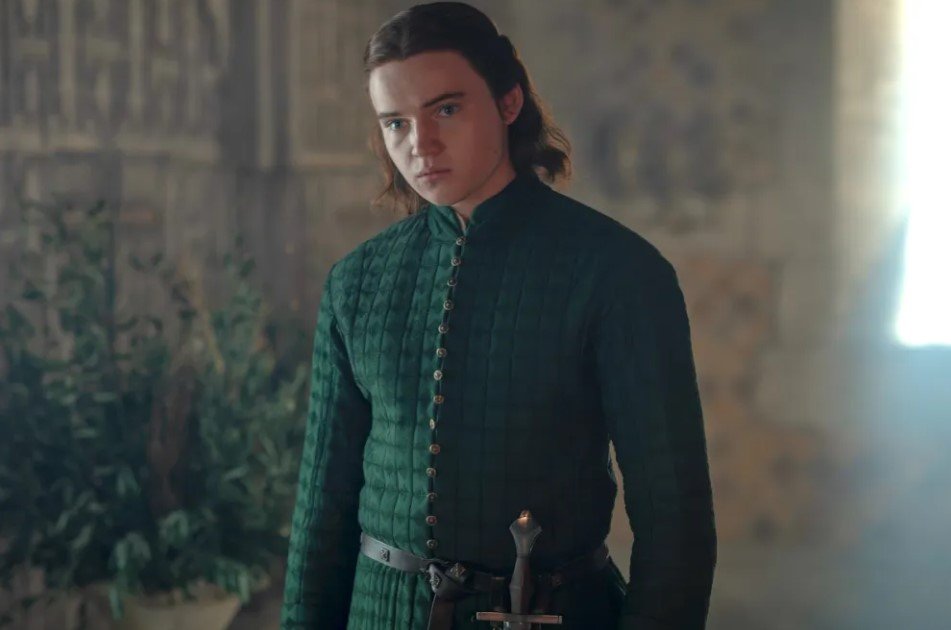
Daeron and Gwayne House of the Dragon builds into one of Episode 6’s more understated but meaningful developments, giving the show’s youngest political pawn a genuine adult ally for the first time all season. It’s a relationship that emerges directly out of crisis, and it may end up reshaping how Daeron sees his own place in the war.
“I’m second in line. I’ll head back to Oldtown and pick up the pieces.” — Gwayne, explaining his intentions to Daeron.
How Gwayne Saves Daeron’s Life
Daeron and Gwayne House of the Dragon centers on the assassination attempt that nearly kills both Daeron and Ormund at Tumbleton. When a disguised group of Rhaenyra’s assassins arrives posing as Baratheon envoys come to swear fealty, Ormund proudly presents Daeron to receive their homage — unknowingly placing him directly in danger. Gwayne is the only person at the table who recognizes the deception in time, cutting down the attackers before they can reach Daeron. It’s a moment of genuine, decisive protection that Ormund, for all his scheming, fails to provide.
Read more: Rhaenyra’s Fake Baratheon Assassins in House of the Dragon Explained
The speed of Gwayne’s reaction is worth dwelling on. Everyone else at the table, including Ormund, is entirely fooled by the disguise, distracted by the ceremony of the moment and eager to accept what looks like a genuine political win. Gwayne’s attention to a single inconsistency — that the man claiming to be Arrion Baratheon doesn’t match the real Arrion’s appearance — is what prevents a bloodbath. It’s a small detail with enormous consequences, and it establishes Gwayne as someone whose competence isn’t just theoretical.
Why This Moment Changes Daeron’s Perspective
Daeron and Gwayne House of the Dragon uses the aftermath of the attack to highlight a contrast that’s been building for multiple episodes. Ormund has spent the season using Daeron as a symbol — minting coins with his face, teaching him carefully chosen history lessons, positioning him as a king in waiting without much apparent concern for Daeron’s own wellbeing or agency. Gwayne, by contrast, acts purely to protect him, with no larger agenda attached. For a teenager being actively molded into a political weapon by everyone around him, having someone step in without an obvious angle appears to genuinely register.
Read more: House of the Dragon Season 3 Episode 6 Recap: Faceless Men Ends With a Death and a Kidnapping
It’s worth considering just how isolated Daeron has been up to this point. He’s surrounded by adults with agendas — Ormund grooming him for a throne he never asked for, various lords and envoys treating him as a symbol rather than a person, and even his own family reduced to distant, complicated relationships shaped by the war. Gwayne represents something Daeron hasn’t had access to all season: an adult whose first instinct is protection rather than positioning. That distinction matters enormously to a character the show has consistently portrayed as young, uncertain, and quietly overwhelmed by what’s being asked of him.
Why Gwayne Considers Leaving Tumbleton
Daeron and Gwayne House of the Dragon takes an interesting turn when Gwayne, despite his heroics, tells Daeron he intends to head back to Oldtown rather than remain at Tumbleton. As second in line within the Hightower family hierarchy, Gwayne frames his departure practically — there’s work to do repairing Oldtown’s position, and he’s sympathetic to how unstable Ormund’s leadership has become without necessarily wanting to stay and manage it directly. For Daeron, watching the one adult who protected him prepare to leave adds another layer of uncertainty to an already precarious situation.
Gwayne’s hesitation to fully commit to Tumbleton also reflects his own complicated relationship with Ormund. The two are family, bound by the same house and the same cause, but the show has repeatedly hinted that Gwayne finds Ormund’s methods — the paranoia, the volatility, the increasingly erratic decision-making — difficult to stomach. Choosing to step back rather than fully align himself with Ormund’s campaign suggests Gwayne is trying to protect his own position and reputation as much as he’s trying to protect Daeron, even if the two goals happen to overlap in this particular moment.
What This Means for Ormund’s Control Over Daeron
Daeron and Gwayne House of the Dragon puts real pressure on the dynamic Ormund has spent the season carefully constructing. Ormund’s entire strategy depends on Daeron trusting him completely — accepting his guidance, his history lessons, and his framing of what kind of king Daeron should become. A near-death experience that Ormund’s own carelessness helped enable, followed by a rescue from someone else entirely, is exactly the kind of event that could start eroding that trust. If Daeron begins looking to Gwayne rather than Ormund for guidance, it threatens the foundation of Ormund’s entire southern campaign.
Read more: The Fake Baratheon Envoy in House of the Dragon Explained
Ormund’s reaction to the attack only reinforces this problem. Rather than responding with composure or reassurance, he’s left visibly shaken and physically ill, vomiting from the smell of the aftermath — hardly the image of a steady, capable protector that Daeron needs to believe in if Ormund’s entire project of positioning him as a future king is going to hold together. The contrast between Ormund’s undignified collapse and Gwayne’s calm, decisive action couldn’t be starker, and it’s exactly the kind of contrast that tends to matter to someone as young and impressionable as Daeron.
Does This Storyline Follow the Books
Daeron and Gwayne House of the Dragon appears to be a largely original dynamic, since George R.R. Martin’s Fire & Blood doesn’t provide extensive detail on a close personal relationship between Daeron and Gwayne Hightower during this stretch of the war. The show has used original material throughout Season 3 to flesh out Daeron’s inner life and his relationships with the various Green faction adults managing his political rise, and this storyline continues that pattern, giving weight to a character who exists in the books primarily as a political instrument rather than a fully realized personal arc.
This kind of expansion fits a broader trend across the season, where the show has consistently given more interiority to characters who remain relatively flat or underdeveloped in the historical record Fire & Blood presents. Daeron’s arc benefits significantly from having a genuine relationship to anchor his perspective, rather than existing purely as a name and a claim being fought over by adults with competing interests.
What Comes Next for Daeron
Daeron and Gwayne House of the Dragon leaves real uncertainty about where this relationship goes from here, particularly if Gwayne follows through on his stated plan to return to Oldtown. Whether Daeron finds a way to keep Gwayne close, whether Ormund tightens his grip in response to the growing rift, or whether Daeron begins asserting more independence of his own are all questions the season’s final two episodes are well positioned to address.
House of the Dragon | Episode 7 Preview | HBO Max
FAQ
How does Gwayne save Daeron’s life in House of the Dragon Episode 6? He identifies a group of disguised assassins posing as a Baratheon envoy and cuts them down before they can reach Daeron, who Ormund had just presented to receive their supposed fealty.
Why does Daeron start trusting Gwayne more than Ormund? Gwayne’s decisive, selfless protection contrasts sharply with Ormund’s pattern of using Daeron as a political symbol without prioritizing his actual safety.
Does Gwayne leave Tumbleton after saving Daeron? He tells Daeron he intends to return to Oldtown, framing it as practical necessity rather than abandonment, though it remains unconfirmed whether he follows through.
Is the Daeron and Gwayne relationship based on the books? It appears to be a largely original dynamic, since Fire & Blood doesn’t provide extensive detail on a personal relationship between the two characters at this point in the war.
Could this relationship threaten Ormund’s influence over Daeron? Potentially. Ormund’s strategy depends heavily on Daeron’s trust, and a rescue that exposes Ormund’s own carelessness, combined with his visibly shaken reaction to the attack, could begin shifting where Daeron looks for guidance.