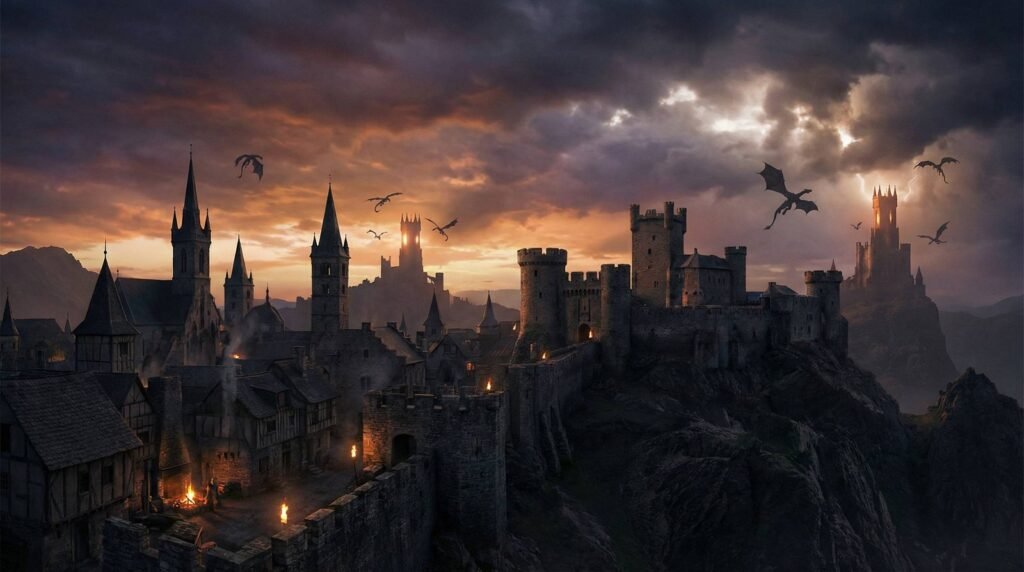
Understanding Battle at Rooks Rest explained is essential for grasping the first major dragon-versus-dragon clash of the Dance of the Dragons. Up until 129 AC, the civil war between Queen Rhaenyra’s Blacks and King Aegon II’s Greens had been fought largely through ravens, naval blockades, and isolated skirmishes.
Everything changed when Hand of the King Ser Criston Cole marched a Green army out of King’s Landing toward a minor coastal castle in the Crownlands. Examining Battle at Rooks Rest explained reveals how Cole used a seemingly insignificant fortress as bait to lure Princess Rhaenys Targaryen and her swift dragon Meleys into a devastating two-dragon ambush.
Ser Criston Cole’s Crownlands Bait Strategy
A key foundation in Battle at Rooks Rest explained begins with Ser Criston Cole’s calculated military campaign across the Crownlands. After being named Hand of the King by Aegon II, Cole recognized that the Blacks held a massive numerical advantage in adult dragons, making an open siege of Dragonstone suicidal.
Instead, Cole targeted small castles loyal to Rhaenyra along Blackwater Bay—marching on Duskendale before laying siege to Rook’s Rest, the seat of Lord Staunton:
- Cutting off Dragonstone: By capturing coastal strongholds, Cole aimed to isolate Dragonstone from mainland supplies and reinforcements.
- Forcing a Dragon Response: Lord Staunton had no standing army capable of breaking Cole’s siege, leaving him no choice but to send desperate ravens to Dragonstone begging for dragonfire.
- Setting the Hidden Trap: While Cole’s siege engines bombarded the castle walls, King Aegon II aboard Sunfyre and Prince Aemond aboard Vhagar lay concealed in the nearby woods, waiting for a lone Black dragonrider to answer the call.
Why Princess Rhaenys Answered the Call Alone
Another pivotal element of Battle at Rooks Rest explained lies in the strategic hesitation inside Queen Rhaenyra’s war council on Dragonstone. Still grieving the deaths of her son Lucerys Velaryon and her young cousin Jaehaerys, Rhaenyra refused to send her surviving sons Jacaerys or Joffrey into battle—and she remained reluctant to risk her own life while Daemon was away at Harrenhal.
Read More here – Storming of the Dragonpit Explained: How Smallfolk Killed Five Dragons
Recognizing that failing to defend loyal vassals would destroy Rhaenyra’s credibility across Westeros, Princess Rhaenys Targaryen—known as “The Queen Who Never Was”—volunteered to fly alone atop Meleys, the Red Queen. Fast, cunning, and battle-tested, Meleys was considered the swiftest dragon in the realm, capable of outflying even Vhagar in open skies.
   Ser Criston Cole Besieges Rook's Rest (Bait)
                       │
                       ▼
   Rhaenys & Meleys Arrive & Burn Green Vanguard
                       │
            ┌──────────┴──────────┐
            ▼                     ▼
  King Aegon II & Sunfyre   Prince Aemond & Vhagar
  (Engages Meleys First)    (Ambushes From Above)
            └──────────┬──────────┘
                       ▼
   Sunfyre Crippled | Rhaenys & Meleys Killed
6 Defining Moments From the Battle at Rook’s Rest
To fully appreciate Battle at Rooks Rest explained, we must examine the six critical turning points that unfolded in the skies above Lord Staunton’s castle:
- Meleys Decimates the Green Ground Forces: Arriving nine days after Lord Staunton’s raven reached Dragonstone, Rhaenys swooped low over Cole’s army, roasting hundreds of soldiers and burning siege towers before archers could react.
- Aegon II and Sunfyre Spring the Trap: Believing the ambush belonged to him, King Aegon II burst from the clouds aboard his golden dragon Sunfyre—charging straight at Meleys instead of waiting for Vhagar.
- Meleys Overpowers Sunfyre: Far older and more experienced than Aegon’s young dragon, Meleys locked her jaws onto Sunfyre’s neck and tore into his wing, nearly killing the king within seconds.
- Vhagar’s Crushing Aerial Dive: Prince Aemond One-Eye plunged down from the upper clouds aboard Vhagar, slamming into both locked dragons with colossal force—and blasting fire that scorched both Meleys and his own brother Aegon.
- Rhaenys Chooses Honor Over Retreat: Though Meleys was fast enough to outrun Vhagar back toward Dragonstone, Princess Rhaenys turned back to face Aemond directly, determined to take down the Greens’ deadliest weapon or die trying.
- The Fatal Plunge Into the Ash: Locked in a violent aerial grapple a thousand feet above the battlefield, Vhagar’s jaws snapped Meleys’s neck, sending both the Red Queen and Princess Rhaenys crashing into the burning earth beside the castle walls.
Comparing the Three Dragons at Rook’s Rest
| Dragon & Rider | Faction | Size & Combat Style | Condition After the Battle |
| Meleys & Princess Rhaenys | The Blacks | Medium-large; fastest dragon alive, agile and fierce. | Killed in Action; neck broken by Vhagar, Rhaenys burned beside her mount. |
| Sunfyre & King Aegon II | The Greens | Young-adult; stunning golden scales, fierce but inexperienced. | Critically Injured; wing half-torn off, Aegon suffered shattered bones and severe burns. |
| Vhagar & Prince Aemond | The Greens | Colossal, oldest living dragon; overwhelming brute weight and fire. | Unscathed; emerged victorious, elevating Aemond to Prince Regent. |
How Rook’s Rest Reshaped Both Factions
The aftermath of Battle at Rooks Rest explained transformed the political and military trajectory of the entire civil war. While the Greens technically won the field and captured the castle, the victory came at a crippling cost: King Aegon II was left bedridden in agony and dependent on milk of the poppy for a year, placing power directly into the ruthless hands of Prince Regent Aemond.
Read More here – Battle Above the Gods Eye Explained: Daemon, Aemond, and the Final Duel
Meanwhile, losing Rhaenys—her wisest counselor and most experienced dragonrider—pushed Rhaenyra and Jacaerys to execute the desperate Sowing of the Seeds, recruiting lowborn dragonseeds to claim Vermithor, Silverwing, Seasmoke, and Sheepstealer.
Final Thought
The Battle at Rooks Rest explained stands as the true end of innocence in House of the Dragon. Once three dragons collided in fire and blood above the Crownlands, negotiation became impossible, proving that in a war of dragons, even a tactical victory leaves ashes on both sides.