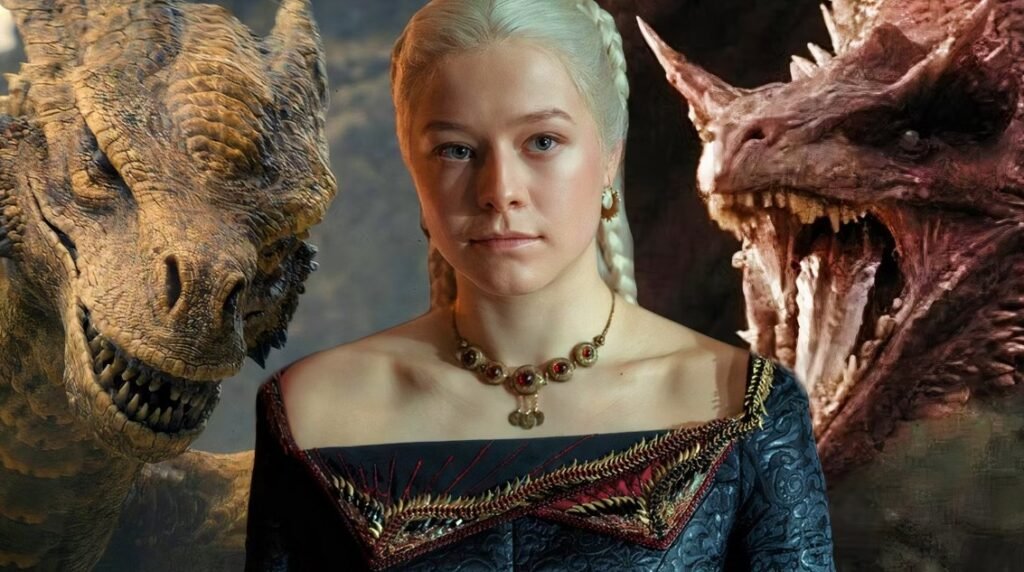
Vhagar explained is essential viewing for anyone trying to understand why the Dance of the Dragons unfolded the way it did.
She is not simply the largest dragon alive during the Targaryen civil war. She is a creature whose age, power, and accumulated history make her a category apart from every other dragon in House of the Dragon — including Rhaenyra’s Syrax and Daemon’s Caraxes.
Vhagar explained properly is the story of a living weapon so overwhelming that whoever rode her held a military advantage that could not be matched by numbers alone.
Understanding her changes everything about how the war between the Blacks and the Greens reads.
Who Was Vhagar?
Vhagar was one of the three dragons that flew with Aegon the Conqueror during his original conquest of Westeros — making her, at the time of the Dance of the Dragons, well over 180 years old.
She was ridden first by Aegon’s sister-wife Visenya — the more austere and martial of the two queens — throughout the conquest and Visenya’s subsequent years of life.
After Visenya’s death, Vhagar lived without a rider for decades, growing larger and more powerful with every passing year.
She was eventually claimed by Baelon Targaryen, then by his son Laena Velaryon — who rode her until Laena’s death in childbirth at the opening of the Dance of the Dragons storyline.
For the full context of Laena’s death and what it meant for the Velaryon family, our House Velaryon Explained article covers the family’s complete role in the war.
How Old Was Vhagar During the Dance?
The vhagar explained age question is one of the most important and least discussed aspects of what makes her so significant.
Dragons grow continuously throughout their lives — larger, stronger, and more destructive with every passing decade.
By the time of the Dance of the Dragons, Vhagar was over 180 years old. She had been alive since before King’s Landing existed. She had flown over the Field of Fire. She had watched six Targaryen kings sit the throne she helped Aegon build.
No other dragon alive during the civil war came close to her age or her size. Caraxes — Daemon’s Blood Wyrm — was formidable and battle-hardened but a fraction of Vhagar’s scale. Syrax, Meleys, Seasmoke — all younger, all smaller, all significantly less powerful in direct combat.
Vhagar explained in terms of military balance is this: one side of the war had a dragon that no other single dragon could match. That fact shaped every major military decision both factions made.
Aemond Claiming Vhagar
The most consequential moment in vhagar explained is Aemond Targaryen’s claiming of the dragon at Driftmark — depicted in House of the Dragon season one as one of the series’ most dramatically charged scenes.
Vhagar had been left riderless after Laena Velaryon’s death. Multiple children were on Driftmark for the funeral — including Baela and Rhaena, Laena’s daughters, who had a natural claim to their mother’s dragon.
Aemond — then a young boy who had failed to bond with any dragon — slipped away in the night and approached Vhagar alone.
His claiming of her was reckless, terrifying, and completely successful. Vhagar accepted him. And in doing so, she transferred the single greatest military asset in Westeros from the Velaryon side to the Green faction — a shift whose consequences the show spent two more seasons unpacking.
The fight that followed — in which Lucerys Velaryon cut out Aemond’s eye with a knife during the confrontation over the claiming — established the personal antagonism between the cousins that would eventually escalate into open war.
For more on Aemond and what his claiming of Vhagar meant for his character, our Aemond Targaryen Explained article covers his complete arc.
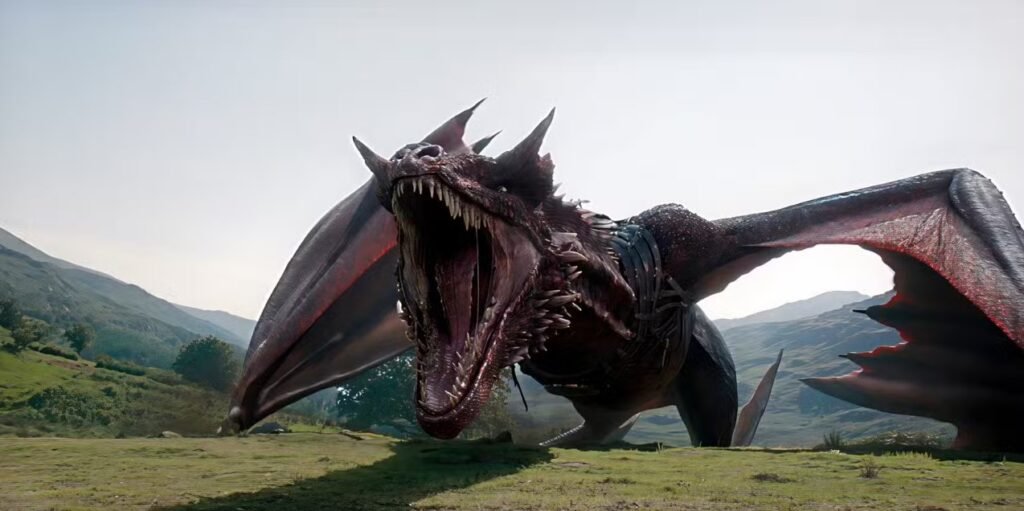
Vhagar’s Role in the Dance of the Dragons
Vhagar explained in military terms across the Dance of the Dragons is the story of a weapon that both factions built their strategies around.
The Black faction knew they could not match Vhagar in direct aerial combat with any single dragon. Their strategy therefore centered on numerical advantage — deploying multiple smaller dragons simultaneously to overwhelm her rather than attempting a one-on-one confrontation.
The Green faction knew Vhagar was their ultimate deterrent. As long as Aemond rode her, no Black dragonrider would willingly seek direct combat. The psychological weight of her presence shaped battlefield decisions on both sides.
Her most significant military action in the war so far was the Battle of Rook’s Rest — where she and Aegon’s dragon Sunfyre ambushed Rhaenys and Meleys. Vhagar’s fire caught not just Meleys but Aegon and Sunfyre simultaneously — an act of either terrible judgment or deliberate fratricide on Aemond’s part that the show leaves deliberately ambiguous.
For the full context of that battle and its consequences, our Dance of the Dragons Explained article covers the complete civil war from beginning to end.
The Death of Lucerys Velaryon
One of the most defining moments of vhagar explained in the show’s narrative is what happened over Shipbreaker Bay at the end of season one.
Aemond pursued Lucerys Velaryon — who was flying his much smaller dragon Arrax — in what he claimed was intended only as intimidation rather than combat.
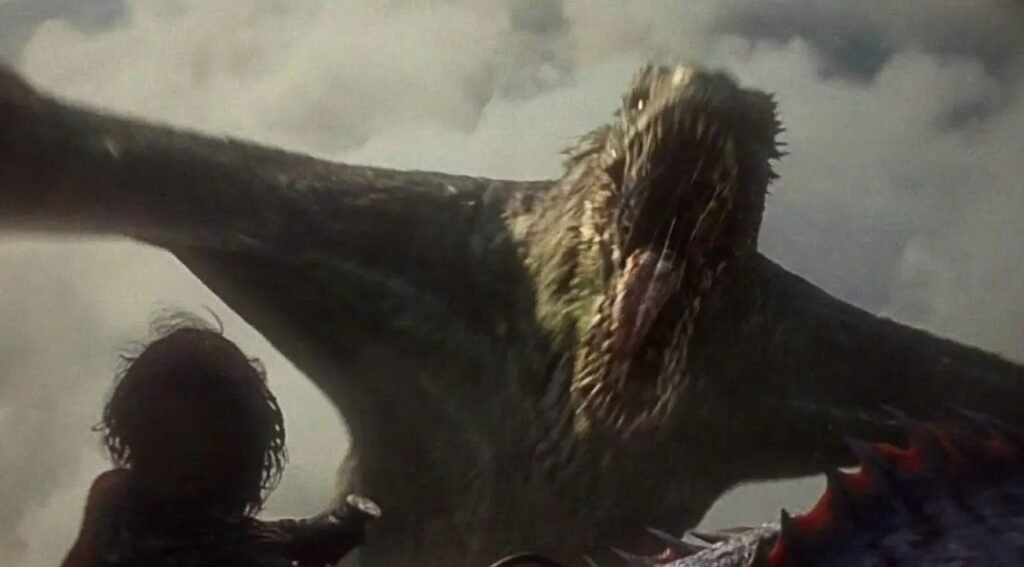
The confrontation escalated beyond Aemond’s control when the dragons’ instincts took over — Arrax breathed fire at Vhagar, and Vhagar responded by killing both Arrax and Lucerys in a single strike.
Vhagar explained at this moment reveals something important about how the show treats dragons. They are not simply vehicles or weapons. They are creatures with their own instincts, responses, and emotional states — capable of acting against their rider’s intentions when sufficiently provoked.
The death of Lucerys was the moment the political dispute between the Blacks and Greens became a blood feud. And Vhagar’s power was so overwhelming that there was nothing Lucerys or Arrax could have done to survive the encounter.
For more on Lucerys and what his death meant for Rhaenyra’s cause, our Rhaenyra Targaryen Explained article covers how that loss transformed her personally and politically.
Vhagar and the Battle of the Gods Eye
The most anticipated moment in vhagar explained for readers of Fire and Blood is the Battle of the Gods Eye — the personal confrontation between Daemon Targaryen on Caraxes and Aemond on Vhagar above the lake in the Riverlands.
In George R.R. Martin’s source material, Daemon — knowing he cannot match Vhagar’s raw power — uses an aerial combat strategy that sacrifices Caraxes to bring down Vhagar.
The two dragons become locked together in combat and crash into the Gods Eye lake. Caraxes survives long enough to crawl to shore before dying of his wounds. Vhagar and Aemond are found dead at the lake’s bottom.
Daemon himself is never found.
The vhagar explained end is therefore one of the most dramatic dragon deaths in the history of Westeros — the largest and most powerful dragon alive brought down not by a stronger opponent but by a rider willing to sacrifice everything to eliminate her.
Whether this confrontation falls in season three or is held for season four has not been confirmed. But it represents the inevitable conclusion of the vhagar explained story — a creature of overwhelming power finally meeting the one thing that power cannot overcome: someone willing to die to stop her.
What Vhagar Meant for the War’s Outcome
Vhagar explained in terms of the war’s ultimate trajectory is a study in the limits of overwhelming individual power.
She was the single greatest military asset in the Dance of the Dragons. Her presence gave the Green faction a credible deterrent that kept the Black faction from committing fully to direct aerial assault for most of the war’s duration.
But she could not be everywhere. She could not protect every Green position. She could not compensate for the political failures of Aegon II’s court, the military failures of Criston Cole’s campaigns, or the strategic isolation that the Velaryon blockade imposed on King’s Landing.
Vhagar explained is ultimately the story of what happens when a faction mistakes one overwhelming asset for a comprehensive advantage — and discovers too late that wars are not decided by single weapons, however devastating.
For the complete picture of how the war unfolded around her, our Battle of the Gullet Explained article covers the conflict’s most devastating naval engagement in full detail.
Final Thought
Vhagar explained is ultimately the story of a creature who outlived every world she was born into.
She flew over the Field of Fire with Aegon the Conqueror. She watched the Red Keep rise above King’s Landing. She outlasted every rider, every king, and every political order she was part of — until the Dance of the Dragons finally produced a conflict large enough to consume even her.
She was not simply a dragon. She was a living connection to the conquest that created Westeros — a reminder, flying above every battlefield, that the world the Targaryens built was built on exactly this kind of overwhelming destructive force.
The Dance of the Dragons destroyed most of what the conquest created. Vhagar’s death was the moment that destruction became irreversible.