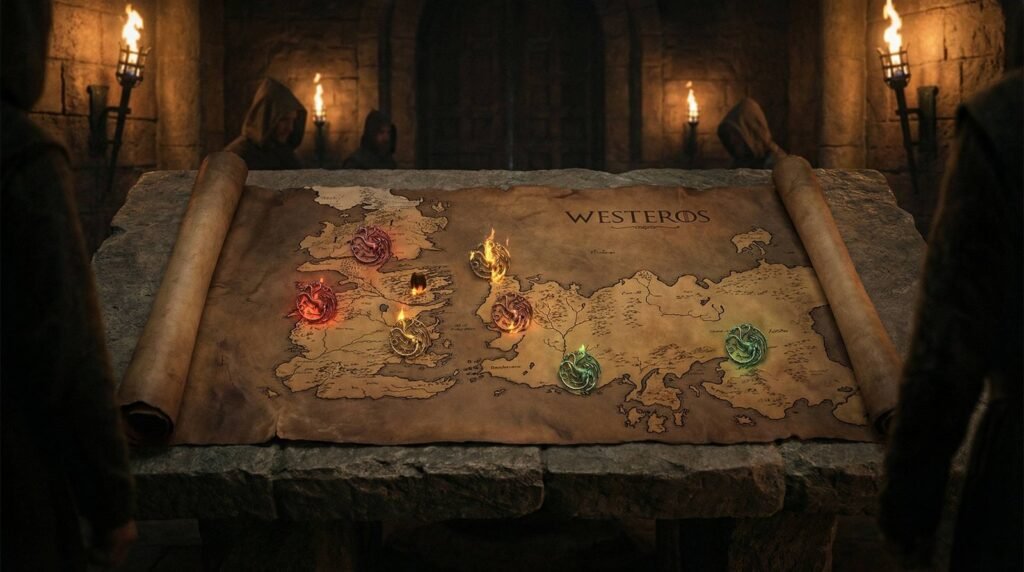
No civil war cast a longer, darker shadow across the Seven Kingdoms than the first dynastic rebellion between the red and black dragons. In this First Blackfyre Rebellion Explained guide, we examine the devastating conflict that erupted when King Aegon IV Targaryen legitimized all his bastard children on his deathbed. That single vindictive decree plunged Westeros into five generations of bloody warfare.
For audiences anticipating HBO’s A Knight of the Seven Kingdoms, understanding this historical conflict is essential. The trauma of the Blackfyre uprising informs every castle gate, tournament meadow, and political grudge depicted in the novellas. Much like our breakdown of the Ira Parker Dunk and Egg 12-season plan, the ideological scars of this civil war serve as the driving engine for the entire era.
Here is the complete, canonical history of the First Blackfyre Rebellion, the warriors who led it, and the fateful battle that decided the Iron Throne.
The Deathbed Curse: Why Aegon IV Legitimized His Bastards
To understand the First Blackfyre Rebellion Explained properly, one must start with King Aegon IV Targaryen, rightfully remembered as “Aegon the Unworthy.” Aegon was a corrupt, self-indulgent king who spent his reign fathering bastards and openly despising his scholarly, lawful son, Prince Daeron.
Aegon took multiple highborn mistresses, fathering four renowned children known as the “Great Bastards”:
- Daemon Waters: Later knighted as Daemon Blackfyre
- Aegor Rivers: Known as “Bittersteel”
- Brynden Rivers: Known as “Bloodraven”
- Shiera Seastar: Celebrated as the realm’s most alluring beauty
               [King Aegon IV Targaryen]
                           │
       ┌───────────────────┴───────────────────┐
       ▼                                       ▼
[Queen Naerys]                          [Noble Mistresses]
       │                                       │
       ▼                                       ▼
[King Daeron II (The Good)]            [The Great Bastards]
                                        ├── Daemon Blackfyre
                                        ├── Bittersteel (Aegor)
                                        ├── Bloodraven (Brynden)
                                        └── Shiera Seastar
When Daemon was just twelve years old, King Aegon knighted him and bestowed upon him the ancestral Valyrian steel sword Blackfyre—the personal blade of Aegon the Conqueror. In feudal Westeros, conferring the Conqueror’s sword to a bastard son rather than the crown prince was seen by many lords as an unspoken royal endorsement.
On his deathbed in 184 AC, Aegon IV struck his final blow against the realm: he formally legitimized every single one of his bastard offspring.
Red Dragon vs. Black Dragon: Two Rival Philosophies
Following the ascension of King Daeron II Targaryen, the realm divided into two distinct cultural and political factions.
King Daeron was an intellectual reformer. He preferred the counsel of maesters, brought the desert principality of Dorne peacefully into the Seven Kingdoms through marriage, and placed Dornish nobles on his royal council. This infuriated traditional marcher lords and martial knights who had spent centuries fighting Dorne.
       [KING DAERON II]                         [DAEMON BLACKFYRE]
       "The Red Dragon"                         "The Black Dragon"
              │                                          │
       ├── Dornish Alliances                     ├── Traditional Martial Values
       ├── Governs via Maesters                  ├── Wields the Sword Blackfyre
       └── Backed by Bloodraven                  └── Backed by Bittersteel
These disgruntled lords gathered around Daemon Blackfyre. Daemon was tall, broad-shouldered, and possessed the silver-gold hair and purple eyes of Old Valyria. Bittersteel constantly urged Daemon to claim the throne, spreading rumors that Daeron II was actually the bastard son of Aemon the Dragonknight.
In 196 AC, Daemon Blackfyre unfurled his personal banner—a black three-headed dragon on a red field—and declared open rebellion.
First Blackfyre Rebellion at a Glance
| Key Dimension | Historical Detail |
| Year of War | 196 AC (Reign of King Daeron II) |
| Key Pretender | Daemon I Blackfyre (“The King Who Bore the Sword”) |
| Loyalist Leaders | Prince Baelor Breakspear, Prince Maekar, Brynden Rivers (Bloodraven) |
| Rebel Leaders | Daemon Blackfyre, Aegor Rivers (Bittersteel), Quentyn Ball |
| Decisive Battle | The Battle of the Redgrass Field |
| Canonical Lore Hub | A Wiki of Ice and Fire – First Blackfyre Rebellion |
The Battle of the Redgrass Field: The Climax of the Rebellion
The ultimate showdown of the First Blackfyre Rebellion Explained occurred late in 196 AC on an unnamed plain outside King’s Landing, forever remembered as the Battle of the Redgrass Field.
Daemon Blackfyre fought like the Warrior incarnate that day. Wielding Blackfyre, he cut through the loyalist vanguard and personally engaged Ser Gwayne Corbray of the Kingsguard. For an hour, Blackfyre clashed against the Valyrian steel blade Lady Forlorn before Daemon triumphed. In a display of chivalry that cost him the war, Daemon dismounted to ensure Corbray received medical aid rather than continuing his charge.
[Daemon Blackfyre Halts to Tend Wounded]
                  │
                  ▼
[Bloodraven & Raven's Teeth Seize the Weeping Ridge]
                  │
                  ▼
[Storm of Arrows: Daemon & Twin Sons Slain]
                  │
                  ▼
[Hammer & Anvil: Baelor & Maekar Crush Rebel Rear]
That brief hesitation gave Brynden Rivers, known as Bloodraven, the opening he needed. Leading his elite archers, the Raven’s Teeth, Bloodraven took the high ground atop the Weeping Ridge. From three hundred yards away, Bloodraven sent a hail of weirwood arrows rain down on Daemon’s position, slaying the pretender king and his twin sons, Aegon and Aemon.
The battle ended when Prince Baelor Breakspear arrived with an army of stormlords and Dornishmen, smashing the rebel rear while Prince Maekar held the front—a maneuver celebrated as “the hammer and the anvil.”
The Aftermath and Bittersteel’s Vow
Although the loyalists prevailed, the peace was fragile. Aegor Rivers recovered the sword Blackfyre from the bloody mud, slashed out Bloodraven’s eye during a savage retreat, and escaped across the Narrow Sea with Daemon’s surviving sons.
In Essos, Bittersteel founded the Golden Company, a mercenary brotherhood bound by an iron oath: “Beneath the gold, the bitter steel.” For decades, the Golden Company served as the military vanguard for four additional Blackfyre rebellions, keeping Daemon’s claim alive.
Why the Blackfyre Lore Matters for Dunk and Egg
When Ser Duncan the Tall and Egg walk through Westeros in A Knight of the Seven Kingdoms, they live directly inside the fallout of the First Blackfyre Rebellion.
- Loyalties remain fractured, with neighbors quietly harboring old grudges.
- Bloodraven rules King’s Landing as Hand of the King, deploying spies and shadow magic to weed out traitors.
- Everyday knights must constantly navigate accusations of treason based on which side their fathers fought for at the Redgrass Field.
Understanding the First Blackfyre Rebellion explains why simple hedge knights carry such immense political baggage—and why the realm remains a powder keg waiting for the next spark.
Frequently Asked Questions About the First Blackfyre Rebellion
Why did Daemon Blackfyre believe he was the rightful king?
Daemon claimed the throne because his father, King Aegon IV, granted him the ancestral Targaryen sword Blackfyre and legitimized him. Supporters also claimed King Daeron II was an illegitimate child born of incest between Queen Naerys and Aemon the Dragonknight.
Who won the duel between Bloodraven and Bittersteel?
During the retreat at the Redgrass Field, Bittersteel engaged Bloodraven in single combat, slicing out Bloodraven’s left eye before escaping to the Free Cities with the Blackfyre heirs.
What happened to the sword Blackfyre after the rebellion?
Bittersteel retrieved Blackfyre from the battlefield and carried it across the Narrow Sea into exile. The sword was passed down through the Blackfyre pretenders and remains hidden in Essos.