
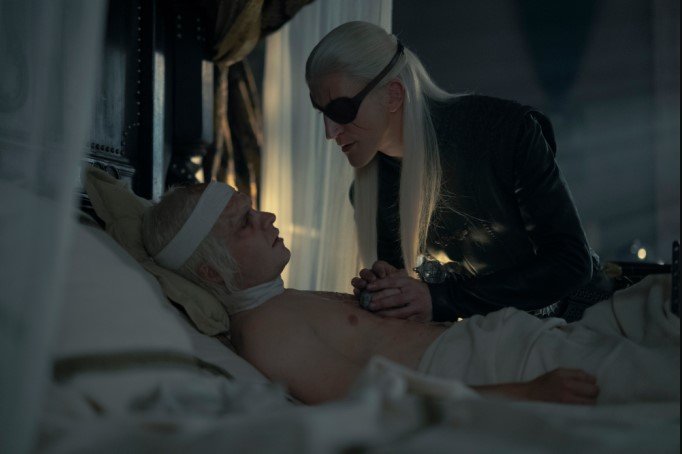
The aegon aemond rivalry season 3 is a storyline that does not exist in Fire and Blood.
George R.R. Martin never wrote Aegon II consumed by a desire to kill his own brother. Their relationship in the source text is complicated — resentment, competition, mutual undermining — but not this.
The season 3 trailer showed Aegon with a new, hard resolve. Fans who know the books immediately recognized the implication. The show has invented a blood feud between the two brothers that the source material never included.
The fandom is split on whether this is genius or a significant creative mistake.
What the Aegon Aemond Rivalry Season 3 Actually Is
The aegon aemond rivalry season 3 arc begins at the Battle of Rook’s Rest.
Aemond flew Vhagar into combat alongside Aegon — and his dragonfire caught not just the enemy but his own brother. Aegon and Sunfyre were burned. Severely.
In the show, this is increasingly being framed as potentially deliberate. The season 3 trailer confirms Aegon enters the new season consumed by the desire to settle that score.
The aegon aemond rivalry season 3 premise asks the question: what does a burned king do when he believes the person who burned him is sitting on his throne?
That premise did not exist in the books. In Fire and Blood, Aemond serves as regent during Aegon’s incapacitation without the source text suggesting Aegon suspects fraternal betrayal. The relationship is competitive but not murderous.
The show has invented the murder motive. And it has done so in a way that generates immediate dramatic questions — because Aemond with Vhagar is essentially unbeatable, and Aegon without Sunfyre has no dragon to fight him with.
Read more: Aegon II Targaryen Season 3 Sympathy: Why HBO Is Making Him Harder to Hate
Why This Change Is Genuinely Interesting
The aegon aemond rivalry season 3 book change deserves more credit than the initial fandom reaction gave it.
In Fire and Blood, the Green faction’s internal dynamics are relatively underdeveloped. Aemond is simply more capable than Aegon and acts accordingly. There is no dramatic engine driving their relationship beyond basic sibling competition.
The show has added something the source text lacked — a specific, visceral, personal conflict between the two Green faction principals that reflects the broader war’s themes directly.
Both brothers are products of the same family dysfunction. Both were formed by the same absent father and politically calculating mother. Both were placed in positions they were not equipped for by circumstances neither chose.
The aegon aemond rivalry season 3 is the Green faction’s Dance of the Dragons in miniature — two people who should be allies destroying each other because the system around them made cooperation impossible.
That thematic coherence is the best argument for the change. It does something the source text leaves underdeveloped.
Read more: House Hightower: The Powerful Family Behind the Green Council’s Ruthless Rise
Why Book Readers Are Concerned
The aegon aemond rivalry season 3 book change has generated significant pushback in fandom communities — particularly among Fire and Blood readers.
The concern is not that the show invented conflict. It is that the specific conflict invented may contradict how Aemond’s character actually functions.
In the source text, Aemond is ruthless but not reckless. He operates with political intelligence — serving as regent effectively, making calculated decisions rather than emotionally driven ones.
An Aemond who deliberately burned his own king during battle — which the show is implying without confirming — would be making a catastrophically reckless political decision that risks destroying the very cause he has been working to advance.
The aegon aemond rivalry season 3 book reader concern is this: the show may be giving Aemond an emotional motivation that undermines the cold strategic intelligence that made him compelling in the first place.
Some fans believe this is a fair concern. Others argue that ambiguity — was it deliberate or accidental? — is more interesting than either clean reading.
Read more: Aemond Targaryen: The Ruthless Prince Who Almost Won the War

Credit : Screen Rant — Aemond Targaryen on the Iron Throne production stills
What Makes the Rivalry Work Dramatically
Setting aside book accuracy, the aegon aemond rivalry season 3 has genuine dramatic potential that the show appears to be exploiting thoughtfully.
Aegon burned and diminished, without his dragon, facing a brother who has everything he lacks — military capability, an operational dragon, the respect of the court — is one of the most dramatically loaded character positions in the season.
A king reduced to the level of an ordinary man, knowing the person who reduced him is sitting his throne, surrounded by advisors who have already moved on.
The aegon aemond rivalry season 3 dynamic transforms Aegon from a passive figure recovering from injuries into an active protagonist with a specific goal — even if that goal is self-destructive by any rational measure.
That activation is what makes the aegon aemond rivalry season 3 change defensible on pure storytelling terms. Season 2 Aegon was reactive. Season 3 Aegon has an agenda. Good drama requires characters with agendas.
Whether the specific agenda — kill his own brother — is the right one is the debate the fandom is having.
Read more: House of the Dragon Season Three Book Changes: The Biggest Departures From Fire and Blood
Frequently Asked Questions
Does Aegon try to kill Aemond in Fire and Blood? No. The aegon aemond rivalry season 3 blood feud is a show invention. In the source text their relationship is competitive and resentful but does not involve a murder motive. The show has added this conflict based on the Battle of Rook’s Rest — where Aemond’s dragonfire burned Aegon — framing it as potentially deliberate.
Did Aemond deliberately burn Aegon at Rook’s Rest? The show has deliberately left this ambiguous. The aegon aemond rivalry season 3 premise allows both readings — accident or attempted fratricide. The ambiguity is likely intentional, as a confirmed deliberate attack would require specific plot handling that unambiguous accident or unambiguous murder would not.
Why is the Aegon and Aemond rivalry controversial among fans? Book readers are concerned the show is giving Aemond an emotional motivation — fratricidal rage or political opportunism — that contradicts his characterization as a cold strategic operator. The aegon aemond rivalry season 3 book change also has no equivalent in Fire and Blood, making it one of the show’s most significant departures from the source material.
How does the Aegon and Aemond rivalry affect the Green faction? The aegon aemond rivalry season 3 makes the Green faction’s internal situation even more precarious than it already is. A king who suspects his regent of attempted murder, a regent who may have settled into the throne too comfortably, and a faction with no unified leadership heading into the war’s most critical phase — this combination is genuinely dangerous for Green survival.
Final Thought
The aegon aemond rivalry season 3 is the book change that most clearly divides the fandom between those who evaluate the show on its own terms and those who evaluate it against Fire and Blood.
On its own terms it is dramatically intelligent — activating Aegon, adding personal stakes to the Green faction’s internal politics, and creating a conflict that reflects the broader war’s themes at the intimate family level.
Against the source text it is a significant departure — one that changes how both brothers function and that creates narrative obligations the show will need to fulfill carefully.
The aegon aemond rivalry season 3 debate will not be settled until June 21 — when audiences can see whether the show has built something genuinely worthy of the departure it has made, or whether book readers’ concerns about character consistency were justified.
Both outcomes are possible. The trailer suggests the show believes in this change completely.
Read more: House of the Dragon Season 3 Is HBO’s Biggest Risk Yet