House Baratheon explained is the story of one of the most dramatic rises and falls in the entire Game of Thrones universe.
No house in Westerosi history climbed faster or collapsed more completely than the Baratheons.
In a single generation they went from powerful regional lords to rulers of the Seven Kingdoms. In the generation that followed, they destroyed each other in a succession war that tore the realm apart and ultimately left the family without a single legitimate heir.
Understanding house baratheon explained means understanding both the glory and the fatal instability that defined everything the family built.
Who Are the Baratheons?
House Baratheon is the ruling family of the Stormlands — the coastal territory of southeastern Westeros battered by the storms that give the region its name.
Their ancestral seat is Storm’s End — one of the most formidable castles in Westeros, built into the cliffs above the Shipbreaker Bay and said to have been raised by Durran Godsgrief, the legendary first Storm King.
The family was founded by Orys Baratheon — a rumored bastard half-brother of Aegon the Conqueror — who was given the Stormlands and the hand of the last Storm King’s daughter as reward for his service during Aegon’s conquest.
House baratheon explained at its foundation is therefore inseparable from the Targaryen dynasty it eventually overthrew — a house born from Aegon’s conquest that ended by destroying what Aegon built.
The Baratheon Sigil and Words
The stag is the sigil of house baratheon explained — a crowned black stag on a field of gold, representing strength, pride, and the ancient Storm Kings whose legacy the family inherited.
Their words are Ours is the Fury — a declaration that captures the Baratheon temperament perfectly.
The Baratheons are not a subtle family. They are large, physically imposing, prone to passion and rage, and most effective when channeling that fury into direct action rather than political maneuvering.
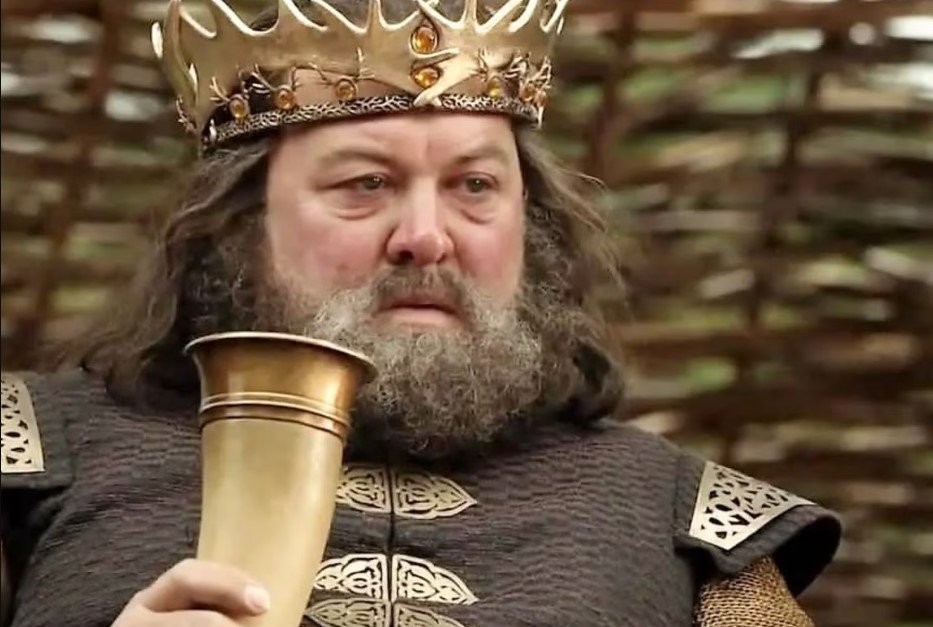
Robert Baratheon embodied this temperament completely — a man of extraordinary physical presence and battlefield brilliance who was constitutionally unsuited to the patience and calculation that ruling a kingdom actually required.
Robert Baratheon: The King Who Won Everything and Lost It All
No discussion of house baratheon explained is complete without examining Robert Baratheon — the man whose rebellion created the dynasty and whose failures destroyed it.
Robert won the Iron Throne through the rebellion that overthrew the Mad King Aerys II Targaryen — a war he fought with genuine brilliance, culminating in his personal defeat of Prince Rhaegar at the Battle of the Trident.
His claim to the throne rested on a distant Targaryen bloodline through his grandmother — thin enough that the real justification was simply that he had won.
He was an extraordinary soldier and a catastrophic king. He spent his reign drinking, hunting, and fathering bastards while the realm’s debts to House Lannister mounted and the political alliances that had won him the crown quietly unraveled.
For the complete story of the war that brought Robert to power, our Roberts Rebellion Explained article covers every cause, battle, and consequence of the uprising in full detail.
The Three Brothers
One of the most important dimensions of house baratheon explained is the dynamic between Robert and his two younger brothers — Stannis and Renly — whose rivalry defined the War of the Five Kings.
Robert took the Iron Throne and the glory of conquest. He was the face of the family, the warrior king, the man whose name the rebellion carried.
Stannis took Dragonstone — the least desirable of the rewards — and spent years defending it with grim efficiency while receiving none of the recognition his service deserved. He was the most capable military strategist of the three and the most rigid in his sense of justice. His belief in his own rightful claim to the throne was absolute and entirely correct — and it made him deeply unsympathetic to everyone around him.
Renly took Storm’s End and the charm that neither of his brothers possessed. He was popular, politically gifted, and entirely willing to use personal charisma as a substitute for legitimate claim. His decision to declare himself king ahead of Stannis — despite being the younger brother with a weaker claim — reflected a political calculation that the lords of Westeros would choose a king they liked over one they respected.
House baratheon explained through the three brothers is a study in how the same family can produce three entirely different relationships with power.
Joffrey and the False Succession
The house baratheon explained story takes its most devastating turn with the revelation about Joffrey Baratheon.
Joffrey — presented as Robert’s heir and crowned king after Robert’s death — was not Robert’s son.
He was the product of Cersei Lannister’s relationship with her twin brother Jaime — a secret that Ned Stark discovered and that cost him his life when he tried to act on it honorably.
The revelation that the Baratheon succession was built on a lie is the pivot on which all of Game of Thrones turns.
Without legitimate Baratheon heirs, the question of who should rule was genuinely open — and every powerful lord in Westeros had their own answer to that question, producing the War of the Five Kings that consumed the realm for seasons three through five.
House baratheon explained is therefore not simply the story of a family’s rise and fall. It is the story of how a false foundation eventually collapses under the weight of what was built on top of it.
Stannis: The Rightful King Nobody Wanted
The most tragic figure in house baratheon explained is Stannis Baratheon — the man who had the strongest claim to the throne and the least ability to persuade anyone to support it.
After Robert’s death, Stannis was the legitimate heir — the eldest surviving Baratheon brother, with a clear legal claim that neither Joffrey’s false succession nor Renly’s popularity could legally override.
He was also humorless, inflexible, and genuinely incapable of the political warmth that wins lords’ loyalty in peacetime.
His alliance with Melisandre and the Lord of Light gave him genuine supernatural power — and cost him the moral credibility he needed to be accepted as a ruler.
His decision to burn his daughter Shireen — the most purely innocent character in the entire series — in a sacrifice to R’hllor destroyed whatever audience sympathy remained for his cause and marked the effective end of House Baratheon as a viable political force.
Gendry: The Last Baratheon
House baratheon explained does not end entirely with Stannis’s death at Winterfell.
Robert Baratheon fathered numerous bastards during his reign — acknowledged by their black hair and Baratheon build — and one of them survived long enough to matter.
Gendry — a blacksmith’s apprentice in King’s Landing — was legitimized by Daenerys Targaryen in season seven, becoming Lord of Storm’s End and the last surviving member of the Baratheon line.
His legitimization and elevation to lordship closed the house baratheon explained story on an unexpected note — a bastard son inheriting the seat his royal father never properly secured.
Gendry’s arc is house baratheon explained in miniature — a family that reached the highest point in Westerosi history and survived only through a line nobody expected to carry it forward.
For more on how Westerosi bastard legitimization worked and why it was such a significant political act, our Iron Throne Succession Explained article covers the full legal framework in detail.
The Baratheon Legacy
House baratheon explained ultimately produced a dynasty that lasted less than twenty years — shorter than almost any other ruling family in Westerosi history.
They won the throne through military brilliance and lost it through political incompetence, personal corruption, and a fundamental inability to build the institutional loyalty that sustains power after the war that won it is over.
Robert was a better rebel than a king. Stannis was a better soldier than a politician. Renly was a better politician than either — but his claim was the weakest of the three and his murder at Melisandre’s hands removed him before he could prove whether charm alone could sustain a reign.
The Baratheons were a family of warriors who inherited a political problem they were not equipped to solve.
For the full story of how the succession crisis they created connected to the broader sweep of Westerosi history, our Dance of the Dragons Explained article covers the earlier civil war whose patterns the War of the Five Kings so closely mirrored.
Final Thought
House Baratheon explained is ultimately a story about the gap between winning power and holding it.
Robert Baratheon was the greatest warrior of his generation. He won a war, killed a prince, and seized the most powerful seat in the world through sheer force of will and martial brilliance.
None of that prepared him for what came after.
House baratheon explained is Westeros’s most compressed demonstration of a principle the entire franchise returns to again and again — that the qualities required to take power are almost never the qualities required to keep it.
The stag burned brightly. It burned briefly. And when it was gone, the Seven Kingdoms were worse off for the vacuum it left behind — a lesson that every house that came after paid for in blood.